Research procedure
Post-election voter survey
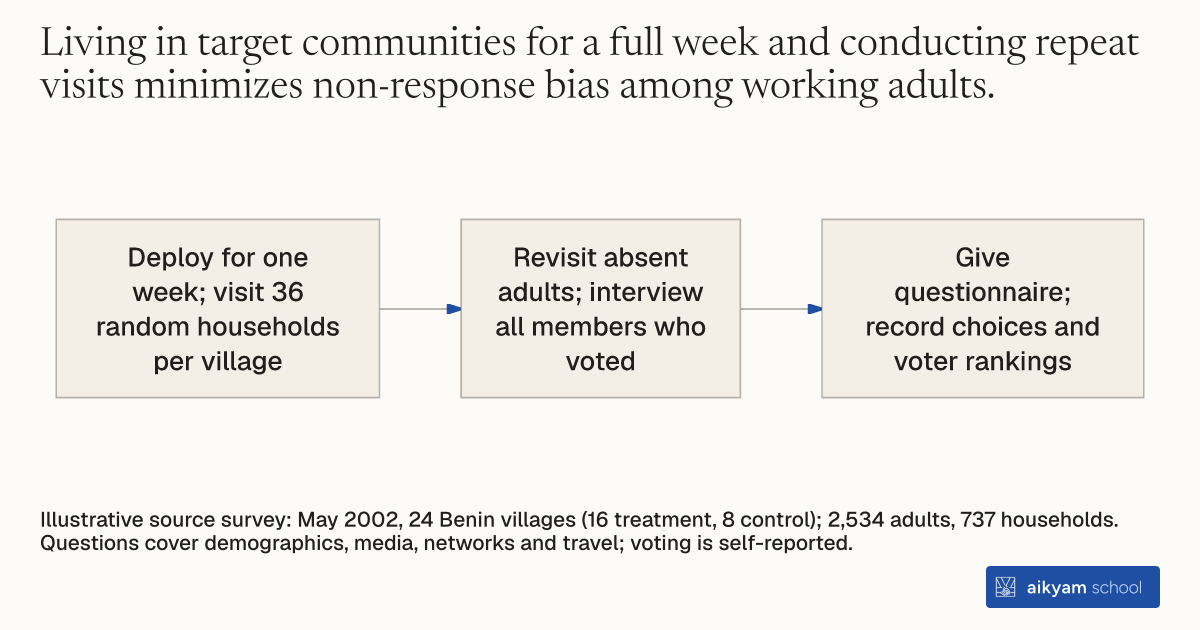
- Deploy for one week; visit 36 random households per village
- Revisit absent adults; interview all members who voted
- Give questionnaire; record choices and voter rankings
Illustrative source survey: May 2002, 24 Benin villages (16 treatment, 8 control); 2,534 adults, 737 households. Questions cover demographics, media, networks and travel; voting is self-reported.
See source →How
When to use
When evaluating campaign experiments or governance programs, evaluators need individual-level data on voting behavior, media access, and social networks. Retrospective surveys risk non-response and recall bias if field protocols are weak. This method provides a structured household survey routine for gathering voter demographic, social network, and electoral data in rural communities.
Collect detailed voter behavior and social network data through structured household surveys following an election.
- Deploy survey teams to assigned villages for one full week per village.
- Visit 36 randomly selected households per village using national census lists.
- Re-visit households multiple times during the week to locate absent adult members.
- Interview all household members who voted in the targeted election.
- Administer a questionnaire covering demographics, media usage, organizational memberships, travel, and political discussions.
- Record self-reported candidate choices and voter rankings for the recent presidential election.
Why it works
Collecting disaggregated indicators on media consumption, organizational ties, and discussions allows evaluators to distinguish distinct mechanisms influencing voter behavior.
Example
In May 2002, survey teams spent one week in each of 24 villages across Benin, successfully interviewing 2,534 voting adults across 737 households.
About the study
Participants
2,534 voting-age adults across 737 sampled households in 24 villages (16 treatment, 8 control) in Benin surveyed in May 2002.
Study Design
Post-election household survey with one-week village residence times, repeated household visits, and standardized questionnaires measuring demographics, media use, network ties, and voting choices.
Results
Surveyors completed an average of 30.7 households per village (85.4 percent of the 36 sampled) with 3.17 respondents per household, resulting in 2,534 completed individual interviews.