Research procedure
Survey voters before results are announced
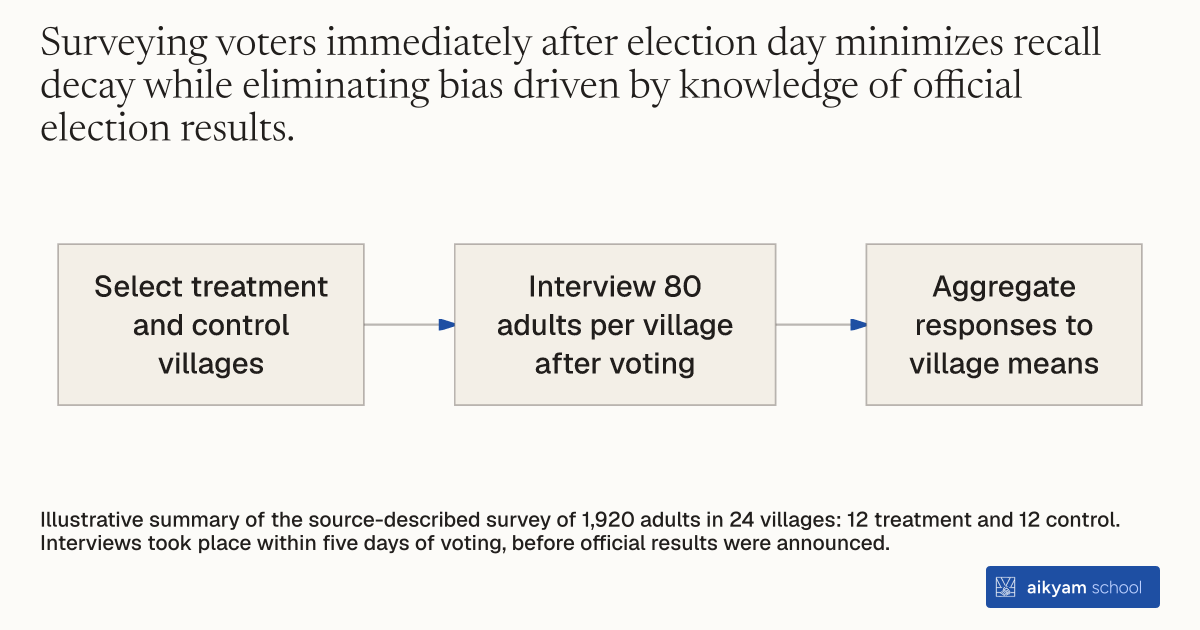
- Select treatment and control villages
- Interview 80 adults per village after voting
- Aggregate responses to village means
Illustrative summary of the source-described survey of 1,920 adults in 24 villages: 12 treatment and 12 control. Interviews took place within five days of voting, before official results were announced.
See source →How
When to use
Evaluating political campaign interventions requires measuring voter behaviors and perceptions immediately following an election. Relying solely on aggregate voting data obscures individual-level shifts in voter information, political discussion, and gift receipt. Administering a representative post-election survey captures fine-grained individual behavioral changes before official results are announced.
Conduct a representative household survey across treatment and control communities immediately following an election to assess voter behavior.
- Select one treatment village and one randomly chosen control village per geographic stratum.
- Sample 80 representative adult citizens aged 18 or older in each selected village.
- Deploy trained enumerators to conduct individual interviews during the five days following election day.
- Complete all field surveys prior to the official announcement of election outcomes to prevent post-outcome bias.
- Aggregate survey responses to village-level means for standardized statistical impact evaluation.
Why it works
Village-level aggregation of representative individual responses provides balanced measures of campaign engagement, policy knowledge, and clientelist exchanges.
Example
In Benin following the March 2006 presidential election, research staff interviewed 80 adult citizens in each of 24 study villages (12 treatment and 12 control villages across 12 communes) within five days of voting. The survey gathered individual-level data on campaign perceptions, vote buying, and political deliberation across ethnic groups.
About the study
Participants
1,920 adult respondents (80 per village) across 24 rural villages in 12 communes in Benin.
Study Design
Stratified representative household survey administered during the 5-day post-election window prior to result announcements, aggregated to village averages.
Results
Captured a statistically significant 0.227 standard deviation reduction in the clientelism index in treatment villages (p-value = 0.024).