Research procedure
Survey households after the election
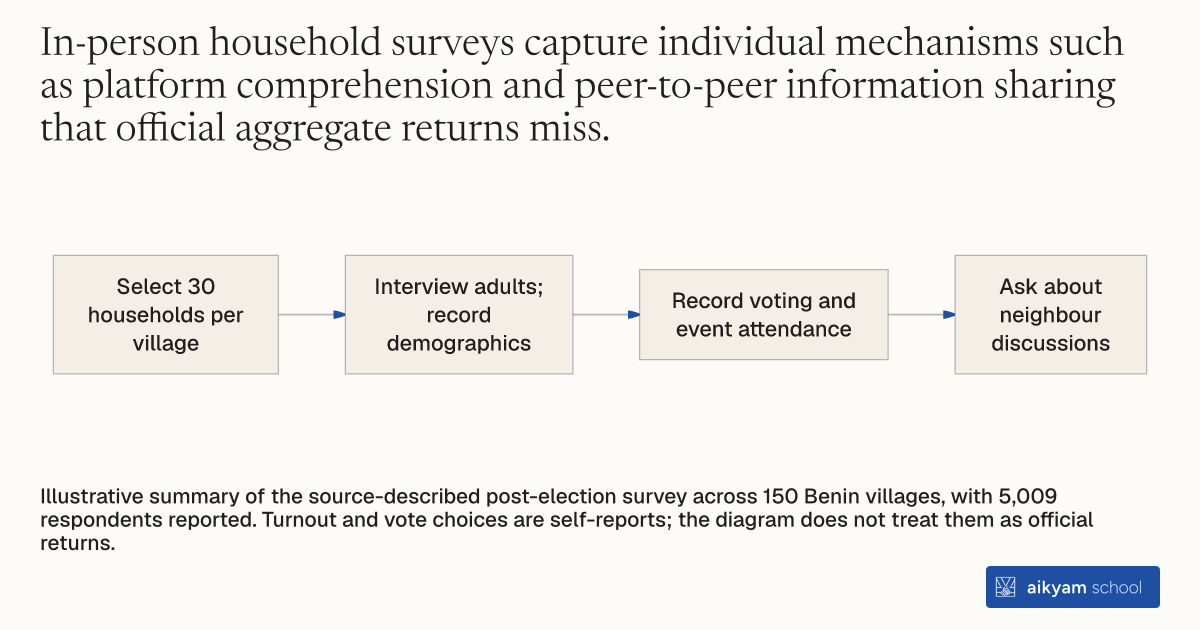
- Select 30 households per village
- Interview adults; record demographics
- Record voting and event attendance
- Ask about neighbour discussions
Illustrative summary of the source-described post-election survey across 150 Benin villages, with 5,009 respondents reported. Turnout and vote choices are self-reports; the diagram does not treat them as official returns.
See source →How
When to use
Official electoral returns often lack individual-level details about voter turnout, candidate preferences, and information sharing. Conduct post-election household surveys to measure individual voting choices and evaluate campaign mechanism effects. This method provides fine-grained data on how specific campaign treatments influenced voter behavior across demographic groups.
Administer a structured post-election survey to representative households in treatment and control communities following voting.
- Select a representative sample of 30 households within each target village.
- Deploy enumerators to conduct in-person interviews with adult residents shortly after election day.
- Record demographic information including age, gender, education, and steady income source.
- Collect individual self-reported turnout and specific candidate vote choices.
- Record attendance at campaign events, town hall meetings, and rallies.
- Measure information sharing by asking whether respondents discussed town hall meeting results with neighbors.
Why it works
Asking detailed questions shortly after an election ensures accurate respondent recall of campaign participation and voting decisions.
Example
Following the March 2011 presidential election in Benin, enumerators surveyed 5,009 respondents across 30 households per village in 150 treatment and control villages to measure self-reported turnout, vote choice, meeting attendance, and peer information sharing.
About the study
Participants
5,009 representative household respondents across 150 villages in 30 electoral districts in Benin.
Study Design
Post-election household survey administered across 60 treatment villages and 90 control villages to evaluate individual-level voting behavior and causal mechanisms using linear probability and IV 2SLS regressions.
Results
Town hall attendance increased individual self-reported turnout by 4.05 percentage points overall (p < 0.001) and vote support for the treated candidate by 16.09 percentage points overall (p < 0.001) and 21.68 percentage points in opposition communes (p < 0.001).