Research steps
List households before baseline sampling
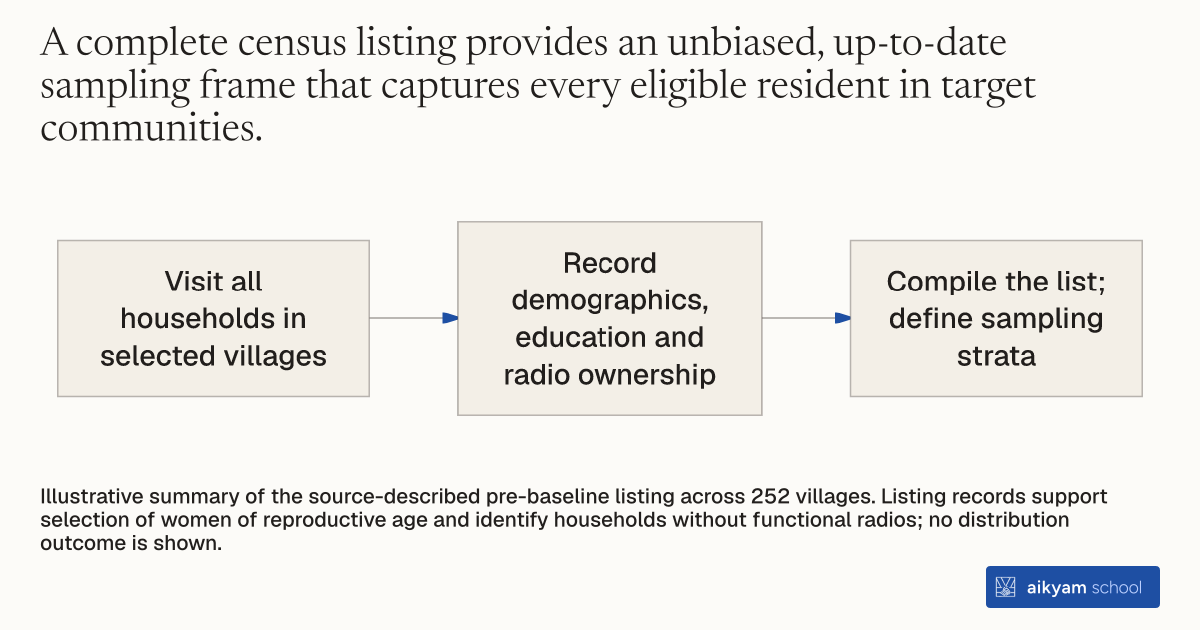
- Visit all households in selected villages
- Record demographics, education and radio ownership
- Compile the list; define sampling strata
Illustrative summary of the source-described pre-baseline listing across 252 villages. Listing records support selection of women of reproductive age and identify households without functional radios; no distribution outcome is shown.
See source →How
When to use
In large-scale field evaluations across rural areas, researchers need to select a representative sample of target individuals without relying on outdated official registries. Existing village records often lack fine-grained data on key demographics like education levels and media asset ownership. Conducting a full pre-baseline household listing census establishes an accurate sampling frame for study participant selection.
Conduct a door-to-door household listing census across target rural villages prior to baseline survey collection to build a comprehensive sampling frame.
- Deploy field enumeration teams to visit every household across selected target rural villages.
- Record basic demographic details for all household members, including age, marital status, and formal education attainment.
- Assess household asset ownership, specifically verifying whether the household owns a functional radio receiver.
- Compile listing census records into a centralized sampling database covering all identified households and women of reproductive age.
- Define sampling strata based on listing variables such as education status and radio ownership to guide representative participant selection.
Why it works
Having pre-baseline data on education and radio ownership allows evaluators to stratify sample selection and balance cluster characteristics effectively.
Example
In Burkina Faso, research teams implemented a comprehensive household listing census across 252 rural villages prior to collecting baseline survey data. This listing census identified women of reproductive age, their formal education status, and household radio ownership, enabling evaluators to sample 7,515 women and distribute solar radios to 1,557 women lacking media access.
About the study
Participants
7,515 women sampled across 252 rural off-grid villages in 16 radio broadcast clusters in Burkina Faso.
Study Design
Complete pre-baseline door-to-door household listing census used for stratified sampling within a two-level cluster RCT.
Results
The household listing census enabled stratified sampling that achieved baseline balance across treatment and control groups and identified 1,557 women in households lacking radio access.