Research steps
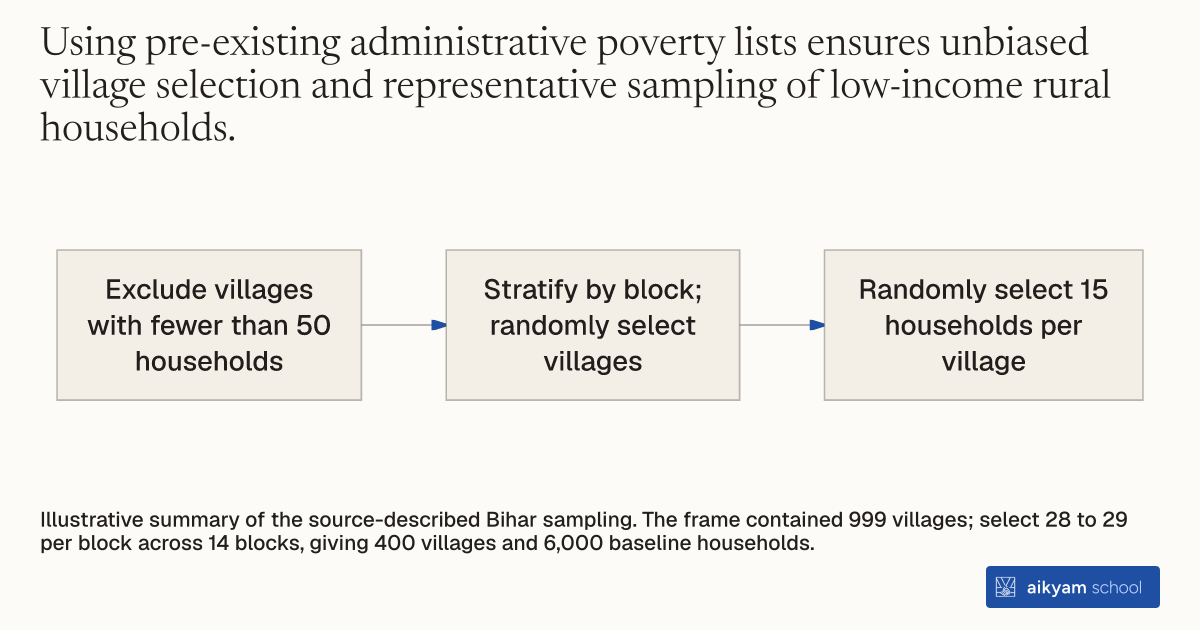
Sample households from official poverty lists
- Exclude villages with fewer than 50 households
- Stratify by block; randomly select villages
- Randomly select 15 households per village
Illustrative summary of the source-described Bihar sampling. The frame contained 999 villages; select 28 to 29 per block across 14 blocks, giving 400 villages and 6,000 baseline households.
See source →How
When to use
In large-scale field evaluations, researchers need an objective and comprehensive sampling frame to select representative rural communities and households. Relying on ad hoc community lists can introduce selection bias and miss vulnerable low-income families. Utilizing official poverty-line registry lists compiled by government development agencies provides a structured sampling frame for field studies across rural districts.
Construct a representative sample of rural villages and households using government poverty census records to conduct field evaluations.
- Obtain the official list of villages and households compiled during government poverty status updates by district rural development agencies.
- Exclude small hamlets containing fewer than 50 households from the experimental sampling frame.
- Stratify the eligible rural villages by administrative blocks across the target district.
- Randomly select 28 to 29 villages per block to form the final sample of study villages.
- Randomly select 15 measurement households per village from the poverty list to participate in field surveys.
Why it works
Random selection within administrative blocks guarantees balanced geographic representation across the entire study district.
Example
Researchers constructed a sampling frame from the District Rural Development Agency list of 999 villages in Bhojpur district, Bihar. They excluded villages with fewer than 50 households and randomly selected 400 villages and 15 households per village, creating a baseline survey sample of 6,000 households.
About the study
Participants
6,000 baseline households (31,710 baseline individuals) across 400 rural villages in Bhojpur district, Bihar, with a 45 percent baseline anemia rate.
Study Design
Stratified random sampling using District Rural Development Agency poverty lists across 14 administrative blocks, assigning 200 villages to sales treatment and 200 to control.
Results
Poverty-line sampling yielded a balanced experimental sample across treatment and control arms with no statistically significant baseline differences in household wealth index (p = 0.610) or member count (p = 0.328).