Research procedure
Allocate backup jobs through assigned probabilities
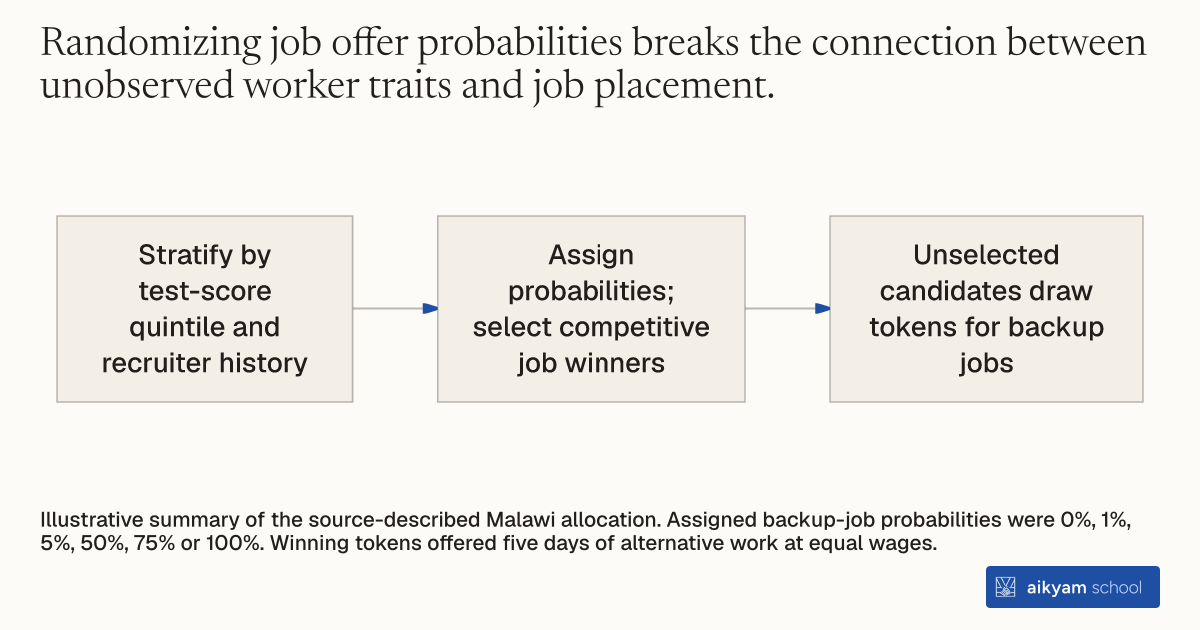
- Stratify by test-score quintile and recruiter history
- Assign probabilities; select competitive job winners
- Unselected candidates draw tokens for backup jobs
Illustrative summary of the source-described Malawi allocation. Assigned backup-job probabilities were 0%, 1%, 5%, 50%, 75% or 100%. Winning tokens offered five days of alternative work at equal wages.
See source →How
When to use
Situations arise where evaluators need to allocate short-term jobs among qualified candidates without bias or favoritism. Selecting candidates through purely competitive filters leaves non-selected applicants without employment experience. Assigning probabilistic job guarantees creates randomized outside options for job seekers during recruitment processes.
Allocate temporary employment opportunities using randomized job probabilities during recruitment screening.
- Register eligible job seekers participating in recruitment training programs.
- Stratify participants into groups based on baseline test score quintiles and past recruiter experience.
- Assign each participant a fixed job offer probability of 0, 1, 5, 50, 75, or 100 percent.
- Select primary job winners based on competitive performance scores during job training.
- Direct unselected participants in probabilistic groups to draw tokens from bags with matching ratios of winning and losing tokens.
- Issue alternative short-term job offers paying equal wages to participants who draw winning tokens.
Why it works
This generates clean exogenous variation in acquired work experience for evaluating subsequent labor market gains.
Example
Recruiters in Lilongwe, Malawi assigned 268 male job seekers probabilistic chances ranging from 0 to 100 percent for backup research jobs. Participants drawing winning tokens from bags loaded with corresponding colored tokens received 5 days of paid alternative work at equal pay.
About the study
Participants
268 male job seekers participating in training in Lilongwe, Malawi, with 227 re-interviewed at follow-up.
Study Design
Randomized Controlled Trial using probabilistic job offer assignments (0%, 1%, 5%, 50%, 75%, 100%) stratified by baseline ability and recruiter history.
Results
Participants assigned 50%, 75%, and 100% job probabilities were 40.2, 56.8, and 83.7 percentage points more likely to acquire employment than the 0% group, producing a first-stage F-statistic of 76.36.