Research steps
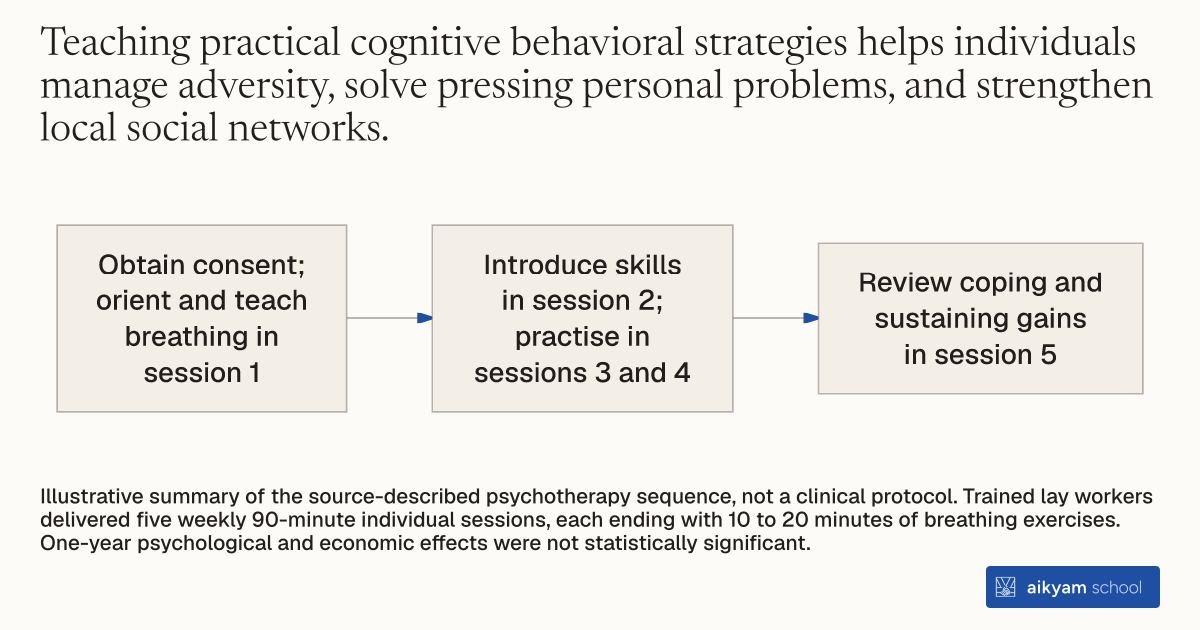
Describe the five-session PM+ sequence
- Obtain consent; orient and teach breathing in session 1
- Introduce skills in session 2; practise in sessions 3 and 4
- Review coping and sustaining gains in session 5
Illustrative summary of the source-described psychotherapy sequence, not a clinical protocol. Trained lay workers delivered five weekly 90-minute individual sessions, each ending with 10 to 20 minutes of breathing exercises. One-year psychological and economic effects were not statistically significant.
See source →How
When to use
Low-resource communities often face widespread psychological distress but lack specialized mental health professionals. This method delivers a brief, structured cognitive behavioral therapy program to distressed individuals using trained community health workers. It serves health and anti-poverty organizations seeking to improve psychological well-being in low-resource settings.
Deliver five weekly individual psychotherapy sessions using trained lay community health workers.
- Lay health workers contact target participants by phone or in person to explain program details and obtain consent.
- Lay health workers conduct Session 1 to orient participants, explain common stress reactions, and teach slow breathing exercises.
- Lay health workers conduct Session 2 to guide participants through problem-solving steps for a self-selected problem and introduce behavioral activation.
- Lay health workers conduct Sessions 3 and 4 to practice problem-solving skills, behavioral activation, and social support strategies.
- Lay health workers conduct Session 5 to review learned coping strategies, plan for sustaining gains, and conclude treatment.
- Lay health workers close each 90-minute session with 10 to 20 minutes of stress-management breathing exercises.
Why it works
Lay delivery allows task-sharing in healthcare systems where professional therapists are unavailable.
Example
In Nakuru County, Kenya, 72 community health workers delivered five weekly 90-minute Problem Management Plus sessions to 1,018 participants across 113 rural villages. After one year, participants showed a 5 percent increase in consumption and asset holdings, but no statistically significant change in psychological well-being or economic outcomes relative to control.
About the study
Participants
5,756 low-income individuals across 233 rural villages in Nakuru County, Kenya, including 525 pure PM+ recipients and 493 combined cash and PM+ recipients.
Study Design
A randomized controlled trial testing five weekly individual PM+ sessions delivered by lay health workers against a pure control group and evaluating outcomes at a 1-year endline survey.
Results
The PM+ program had no statistically significant impact after one year on psychological well-being (-0.01 standard deviations), monthly consumption (+USD 2.49 PPP / 5 percent), asset holdings (+USD 28.75 PPP / 5 percent), or monthly revenue (+USD 11.78 PPP / 9 percent) relative to pure control.