Research steps
Train and supervise lay health workers
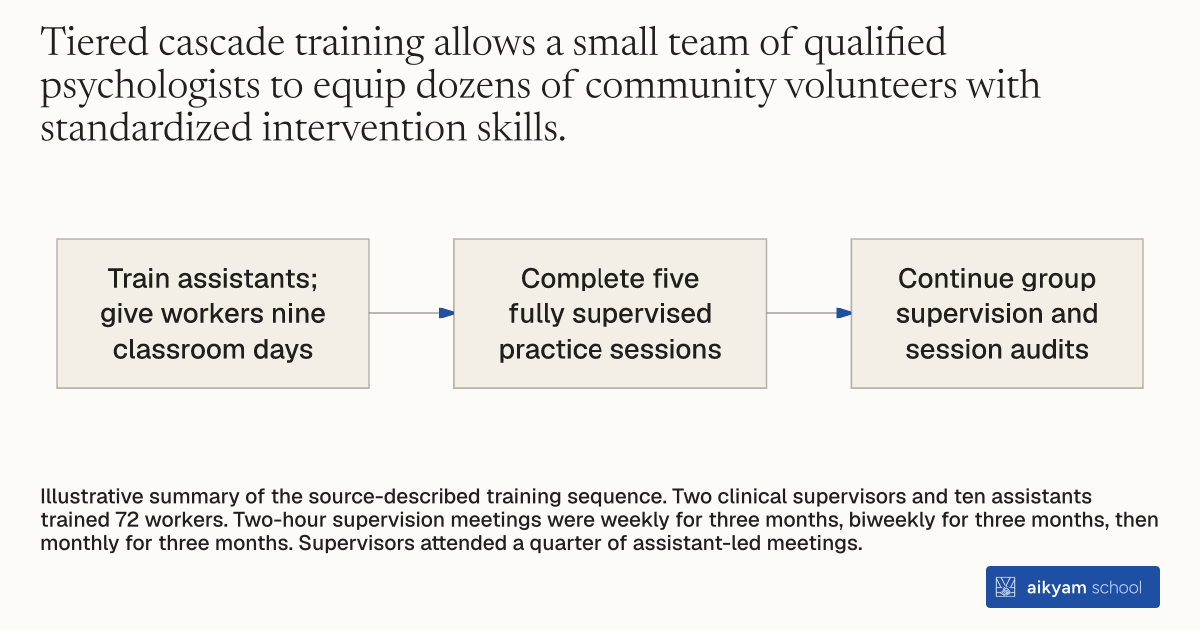
- Train assistants; give workers nine classroom days
- Complete five fully supervised practice sessions
- Continue group supervision and session audits
Illustrative summary of the source-described training sequence. Two clinical supervisors and ten assistants trained 72 workers. Two-hour supervision meetings were weekly for three months, biweekly for three months, then monthly for three months. Supervisors attended a quarter of assistant-led meetings.
See source →How
When to use
Low-income regions frequently lack trained professional psychologists to deliver mental health treatments. This method builds a tiered workforce by training clinical supervisors and local staff to instruct and supervise lay community health workers. It serves health and social care organizations scaling psychosocial programs in resource-poor communities.
Train lay volunteers through classroom instruction, practical field cases, and ongoing group supervision.
- Clinical psychologists train community health assistants in psychosocial concepts and supervision skills.
- Clinical supervisors and health assistants conduct nine days of classroom training for lay community health workers using structured WHO manuals.
- Lay community health workers complete five fully supervised practical sessions with a training client while supervisors observe.
- Health assistants and supervisors conduct two-hour group supervision meetings for lay workers weekly for three months, biweekly for three months, and monthly for three months.
- Clinical supervisors attend a quarter of assistant-led supervisions and conduct random session audits to enforce treatment protocols.
Why it works
Regular group supervision and session audits maintain protocol adherence and prevent quality loss across field cohorts.
Example
In rural Nakuru County, Kenya, an international NGO deployed two clinical supervisors and ten health assistants to train 72 community health workers. The supervisors and assistants conducted 360 in-field supervised training sessions and ran structured group supervisions across multiple intervention cohorts.
About the study
Participants
72 lay community health workers, 10 community health assistants, and 2 clinical supervisors delivering care to 1,018 study participants across rural Nakuru County, Kenya.
Study Design
A randomized controlled trial evaluating a lay-delivered psychotherapy program (Problem Management Plus) structured around a cascade training and supervision model.
Results
Psychotherapy delivered by trained community health workers produced no statistically significant changes in psychological well-being (-0.01 standard deviations) or monthly consumption (+USD 2.49 PPP) relative to control, though out-of-sample analysis showed significant variation in individual counselor effectiveness (0.34 standard deviations).