Try, learn and adjust
Check monthly recognition follows performance records
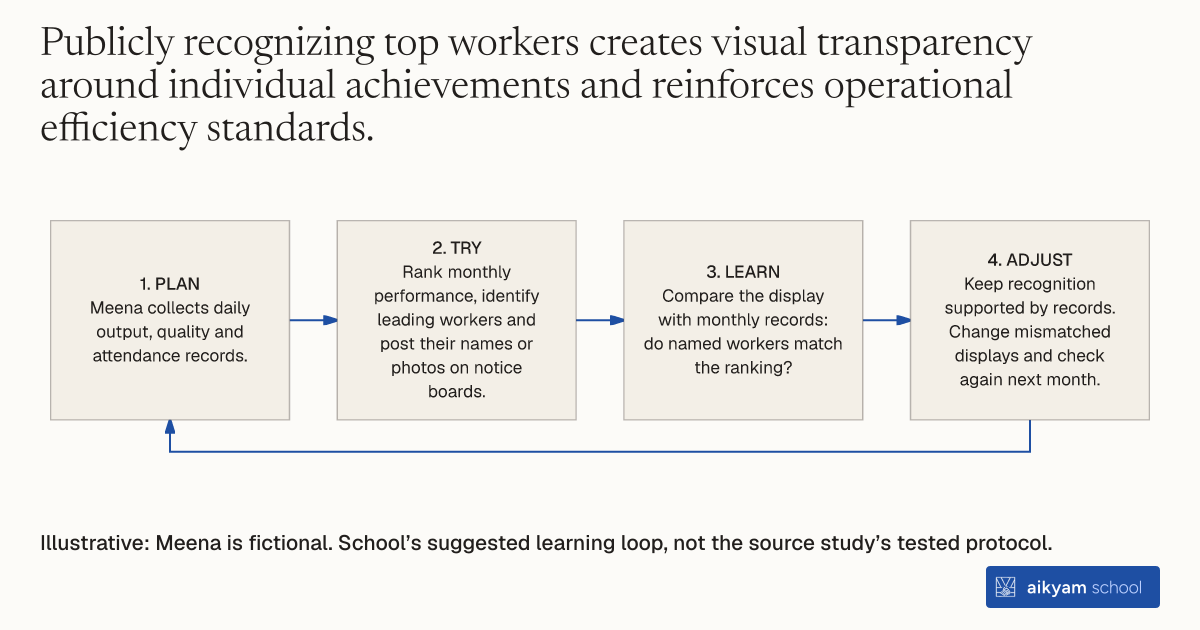
- Plan: Meena collects daily output, quality and attendance records.
- Try: Rank monthly performance, identify leading workers and post their names or photos on notice boards.
- Learn: Compare the display with monthly records: do named workers match the ranking?
- Adjust: Keep recognition supported by records. Change mismatched displays and check again next month.
Illustrative: Meena is fictional. School’s suggested learning loop, not the source study’s tested protocol.
See source →Observe monthly rankings, performance records and public displays. School suggests this learning loop; it is not the source’s tested procedure.
How
When to use
Factory workers often lack motivation when high operational efficiency and quality attendance go unacknowledged by plant management. Traditional mills track individual output on paper sheets without publicly identifying top weavers or rewarding excellence on the shop floor. This method helps factory managers post monthly recognition displays to celebrate top-performing workers and motivate floor staff.
Identify top-performing factory staff each month based on monitored production metrics and display their achievements publicly on shop floor notice boards.
- Floor supervisors collect daily weaver output, quality defect scores, and attendance records.
- Plant managers compile monthly worker performance data to rank factory staff against operational efficiency targets.
- Operations teams identify the top-performing workers across production departments each month.
- Supervisors post photos or names of top factory performers publicly on visual notice boards across the shop floor every month.
- Plant directors acknowledge top performers during monthly staff reviews to reinforce quality and attendance standards.
Why it works
Visual displays on the shop floor encourage workers to improve attendance and operating performance.
Example
International consultants introduced public recognition systems for top factory staff in Indian cotton textile plants near Mumbai, raising adoption of monthly public identification for top performers from 0% to 35.7% in treatment plants.
About the study
Participants
28 plants across 17 large, family-owned cotton textile weaving firms in Tarapur and Umbergaon near Mumbai, India, averaging 273 employees and $7.45 million in annual sales per firm.
Study Design
Randomized controlled trial providing 11 treatment firms with 5 months of management consulting and 6 control firms with 1 month of diagnostic consulting, tracking weekly management practice adoption across ~100 weeks.
Results
Introducing public recognition for top performers alongside visual displays and incentive schemes contributed to a 9.4% increase in factory output (p = 0.026) and a 16.6% increase in total factor productivity (p = 0.061), raising public identification of top factory performers from 0% to 35.7% (a 35.7 percentage point increase) in treatment plants while control plants remained at 0%.