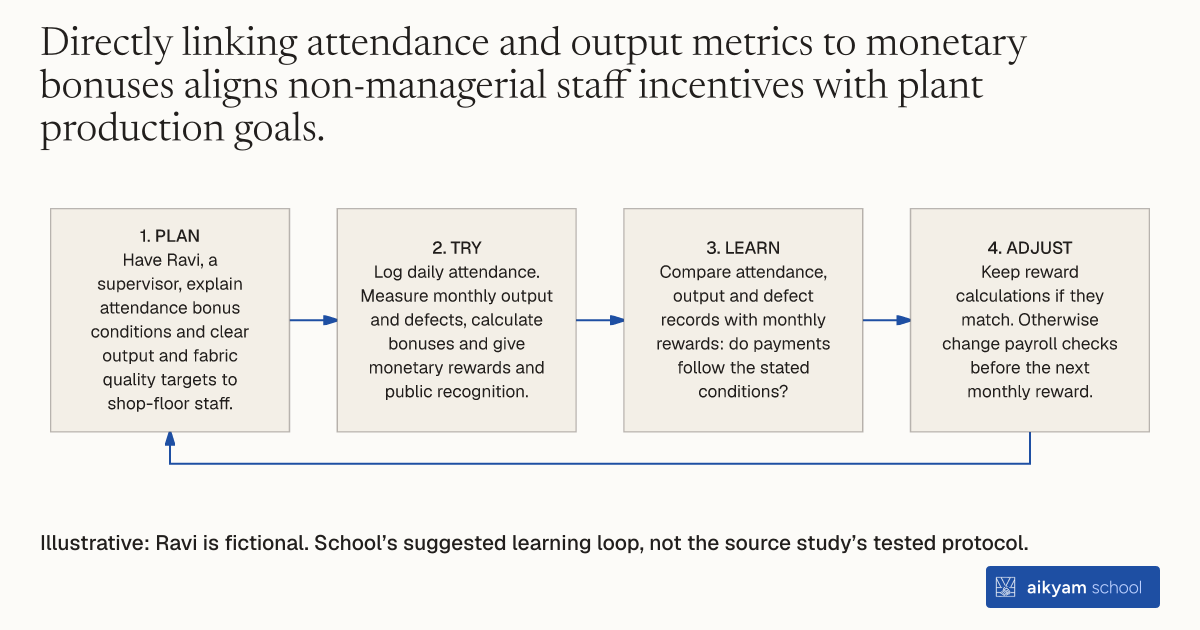
Try, learn and adjust
Check staff rewards against attendance and output
- Plan: Have Ravi, a supervisor, explain attendance bonus conditions and clear output and fabric quality targets to shop-floor staff.
- Try: Log daily attendance. Measure monthly output and defects, calculate bonuses and give monetary rewards and public recognition.
- Learn: Compare attendance, output and defect records with monthly rewards: do payments follow the stated conditions?
- Adjust: Keep reward calculations if they match. Otherwise change payroll checks before the next monthly reward.
Illustrative: Ravi is fictional. School’s suggested learning loop, not the source study’s tested protocol.
See source →School’s suggested, untested loop: observe attendance, output, quality and reward calculations; no productivity gain is assumed.
How
When to use
Manufacturing facilities in developing markets often face high absenteeism and low productivity among non-managerial shop-floor workers. Establishing performance-based financial incentives and attendance rewards motivates shop-floor staff to maintain consistent work schedules and achieve production output targets. This helps plant managers and factory directors stabilize daily workforce presence and improve operational efficiency.
Implement attendance tracking protocols and performance-based reward structures for non-managerial factory employees.
- Factory supervisors record daily worker attendance and shop-floor shift presence on standardized attendance logs.
- Plant managers establish clear physical output and fabric quality targets for non-managerial shop-floor weavers and technicians.
- HR administrators calculate monthly attendance bonuses for workers who maintain perfect or near-perfect attendance records.
- Production supervisors measure monthly individual worker output and defect rates against established performance benchmarks.
- Management disburses monetary performance rewards and publicly recognizes top-performing factory staff during monthly factory meetings.
Why it works
Providing transparent financial rewards encourages consistent daily shift attendance and reduces machine idle time caused by worker absenteeism.
Example
Between 2008 and 2017, international consultants introduced attendance and performance reward systems for non-managerial staff across Indian textile plants near Mumbai. Attendance reward adoption increased from 35% in 2008 to 50% in 2011 and maintained 50% adoption in 2017, with 6 out of 9 adopting plants retaining the practice long-term.
About the study
Participants
28 manufacturing plants across 17 family-owned cotton weaving firms near Mumbai, India, averaging 270 employees, \$8.5 million in assets, and \$7.5 million in annual sales.
Study Design
Randomized Controlled Trial (RCT) tracking 38 management practices across treatment and control plants from 2008 to 2017.
Results
Non-managerial attendance reward system adoption grew from 35% in 2008 to 50% in 2011 and 2017 (with 33% of adopters dropping), while performance reward systems grew from 60% in 2008 to 70% in 2011 and 60% in 2017.