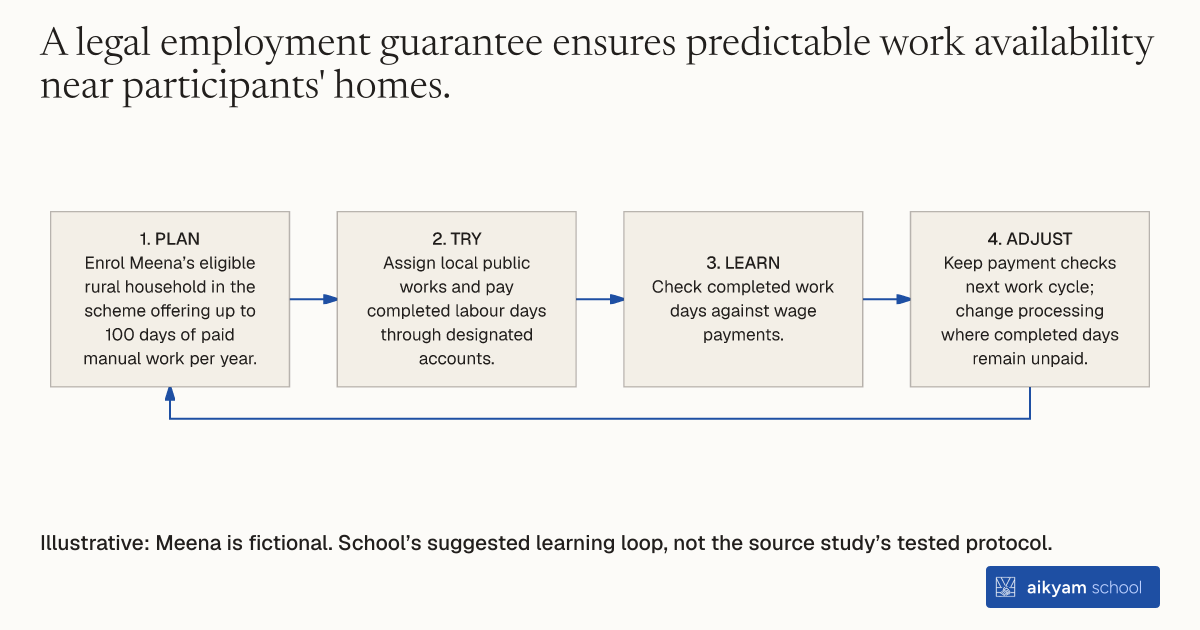
Try, learn and adjust
Check public work is followed by wage payment
- Plan: Enrol Meena’s eligible rural household in the scheme offering up to 100 days of paid manual work per year.
- Try: Assign local public works and pay completed labour days through designated accounts.
- Learn: Check completed work days against wage payments.
- Adjust: Keep payment checks next work cycle; change processing where completed days remain unpaid.
Illustrative: Meena is fictional. School’s suggested learning loop, not the source study’s tested protocol.
See source →School’s suggested learning loop; not a tested source procedure. Observe assigned work, completed days and wages. The scheme’s guarantee is programme context, not a separately randomised treatment here.
How
When to use
Rural households in low-income regions face limited wage labor opportunities, especially for women. Guaranteeing public manual labor provides a reliable source of work and income for families. This method serves rural adults who need local paid employment.
Guarantee up to 100 days of paid manual labor each year to rural residents through a government employment scheme.
- Enroll eligible rural households seeking manual employment in the program database.
- Assign registered workers to local public works projects within their village cluster.
- Conduct manual infrastructure work on project sites according to program schedules.
- Issue government wage payments for completed labor days through designated accounts.
Why it works
It removes access barriers for unskilled job seekers who lack formal employment options.
Example
In Madhya Pradesh, India, the national employment scheme guaranteed 100 days of wage labor each year across 197 village clusters, providing a primary source of work for rural men and women.
About the study
Participants
5,851 women in 197 gram panchayats across Gwalior, Morena, Shivpuri, and Sheopur districts in Madhya Pradesh, India.
Study Design
Randomized controlled trial across 197 village clusters evaluating bank account access, direct deposits, and training using baseline, 2015 short-run, and 2017 long-run surveys.
Results
The scheme guaranteed 100 days of wage labor annually to nearly 600 million rural residents, and three years after program implementation, average total wage deposits reached US$66 among full treatment recipients.