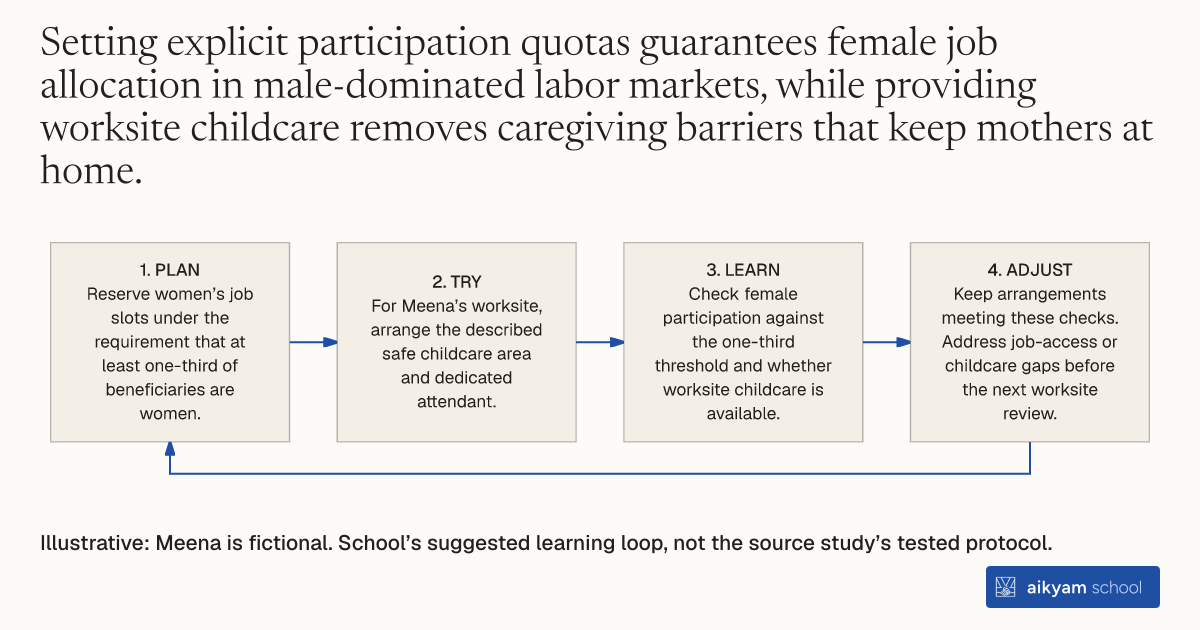
Try, learn and adjust
Check women’s access and worksite childcare
- Plan: Reserve women’s job slots under the requirement that at least one-third of beneficiaries are women.
- Try: For Meena’s worksite, arrange the described safe childcare area and dedicated attendant.
- Learn: Check female participation against the one-third threshold and whether worksite childcare is available.
- Adjust: Keep arrangements meeting these checks. Address job-access or childcare gaps before the next worksite review.
Illustrative: Meena is fictional. School’s suggested learning loop, not the source study’s tested protocol.
See source →School’s suggested, untested loop. Observe female participation and childcare availability; childcare provision is described at some worksites.
How
When to use
In national labor markets marked by wide gender gaps, women who desire work face household caregiving burdens and exclusionary hiring barriers. Public works employment schemes often struggle to recruit rural women unless explicit legal quotas and caregiving supports are established. This method applies statutory female participation quotas alongside worksite childcare facilities to encourage rural women to join public employment projects.
Implement statutory participation quotas and worksite childcare services within public works schemes to enable female labor market entry.
- Public employment program managers mandate a statutory quota requiring at least one-third of project beneficiaries to be rural women.
- Local program officers reserve work openings and job allocation slots specifically for female applicants on rural infrastructure projects.
- Worksite supervisors establish designated, safe childcare areas at active public work project locations.
- Program officers assign dedicated childcare attendants at worksites to care for young children while mothers work.
- Employment officers verify that female participation meets or exceeds the statutory one-third threshold across local project sites.
Why it works
Together, these structural provisions lower entry hurdles and encourage female participation in public employment schemes.
Example
Under the Mahatma Gandhi National Rural Employment Guarantee Scheme in India, national program guidelines mandated that at least one-third of scheme beneficiaries be women alongside worksite childcare provisions, contributing to women completing nearly 42 percent of program workdays in Madhya Pradesh during 2022-2023.
About the study
Participants
9,600 households across 480 Gram Panchayats in 90 blocks of rural Madhya Pradesh, India, where 57 percent of surveyed women were aged 15 to 49.
Study Design
Clustered Randomized Controlled Trial across 90 blocks evaluating public employment uptake, direct deposit wage linkages, and female agency under statutory scheme guidelines.
Results
At baseline, only about 40 percent of Indian women who wanted work were employed compared to 78 percent of men; in Madhya Pradesh, statutory features supported women completing 42 percent of public workdays in 2022-2023.