Research procedure
Recruit and retain deliberation participants
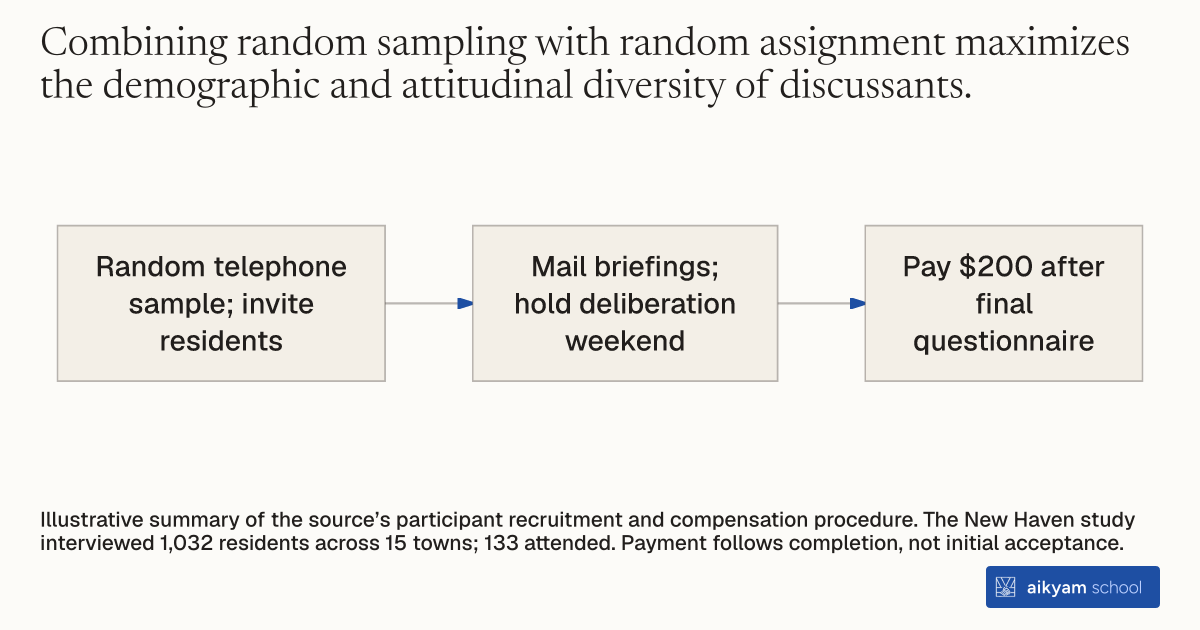
- Random telephone sample; invite residents
- Mail briefings; hold deliberation weekend
- Pay $200 after final questionnaire
Illustrative summary of the source’s participant recruitment and compensation procedure. The New Haven study interviewed 1,032 residents across 15 towns; 133 attended. Payment follows completion, not initial acceptance.
See source →How
When to use
Ordinary public opinion polls capture top-of-the-head reactions from uninformed citizens. Organisers use this method to assemble a representative group of citizens and motivate them to attend a multi-day deliberative event. It provides policy makers with informed public preferences rather than raw, unreflective reactions.
Draw a random sample of citizens, recruit them to attend a deliberative weekend, provide balanced briefing materials, and compensate them upon completing the study.
- Draw a random sample of residents from the target geographic region through initial telephone interviews.
- Invite interviewees to participate in a weekend of deliberation on specified local policy issues.
- Mail carefully balanced briefing materials detailing arguments for and against policy proposals to those who agree to attend.
- Convene participants on-site for small-group discussions led by trained moderators and plenary sessions with policy experts.
- Pay participants a financial inducement of $200 upon completion of the final questionnaire at the end of the weekend.
Why it works
Financial compensation and balanced materials reduce participation barriers and jump-start informed reflection across diverse groups.
Example
Researchers drew an initial interview sample of 1,032 residents across fifteen towns surrounding New Haven, Connecticut. A total of 133 participants attended the deliberative weekend from March 1 through March 3, 2002, and received $200 after completing T3. Attendance yielded a representative cohort comparable to nonparticipants in income, gender, race, and voter registration, despite slight geographic and educational skew.
About the study
Participants
Initial interview sample of 1,032 residents from 15 towns surrounding New Haven, Connecticut, with 133 attending the event. Participants were 50.8% male, 49.2% female, 72.7% Caucasian, 12.1% African American, 3% Hispanic or Latino/a, and 90.2% registered voters, with an average age of 50.1 years.
Study Design
Researchers conducted initial telephone interviews at T1, mailed briefing materials to accepting respondents, held a weekend deliberative event with small groups and expert panels, and administered written questionnaires at T2 and T3.
Results
Out of 1,032 initial interviewees, 133 participants attended the weekend session. Overall factual knowledge across eight test items increased by 22.3%, rising from 36.8% correct at T1 to 59.1% correct at T3. Average knowledge on revenue-sharing items increased by 34.5%, rising from 25.4% at T1 to 59.9% at T3.