Research procedure
Verify reported transactions by phone
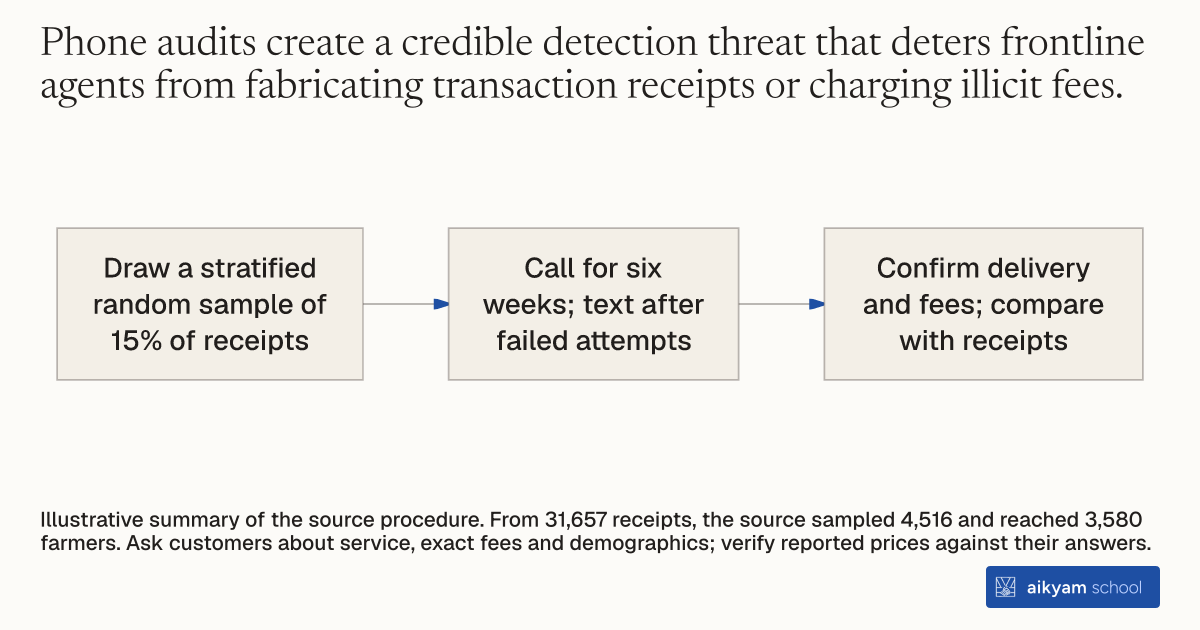
- Draw a stratified random sample of 15% of receipts
- Call for six weeks; text after failed attempts
- Confirm delivery and fees; compare with receipts
Illustrative summary of the source procedure. From 31,657 receipts, the source sampled 4,516 and reached 3,580 farmers. Ask customers about service, exact fees and demographics; verify reported prices against their answers.
See source →How
When to use
Central authorities face severe reporting fraud when assessing public service delivery across remote regions. Direct physical inspection of thousands of decentralized transactions is logistically infeasible and expensive. Randomized phone verification surveys allow administrators to audit receipt validity and track price compliance from central headquarters.
Conduct randomized phone audits on a representative sample of electronically reported transaction receipts to verify service delivery and monitor price compliance.
- Central administrators draw a stratified random sample of submitted transaction receipts from a central electronic database after a service campaign ends.
- Enumerators initiate phone calls to the contact numbers listed on sampled receipts over a six-week audit period.
- Enumerators place calls to each sampled recipient on three different days, scheduling morning and afternoon attempts.
- Survey software transmits automated text messages explaining the call purpose and requesting an interview appointment after every unsuccessful call attempt.
- Survey staff administer a brief questionnaire to reached customers confirming service delivery, exact user fees paid, and recipient demographic details.
- Central analysts calculate agent verification rates and compare reported prices against customer-reported charges to detect non-compliance or fraud.
Why it works
The combination of official paper receipts, mobile submission, and follow-up phone calls enables central oversight without costly physical field inspections.
Example
The Ministry of Agriculture, Livestock and Fisheries in Tanzania conducted a phone verification survey targeting a 15% random sample of 31,657 receipts submitted by 832 livestock extension agents. Enumerators selected 4,516 receipts and successfully reached 3,580 farmers across four regions. The procedure verified that 69% of reported transactions were fully authentic and confirmed high price-cap compliance.
About the study
Participants
3,580 livestock farmers successfully surveyed out of 4,516 sampled receipts (drawn from 31,657 total receipts) across 550 administrative wards in 27 districts of Tanzania.
Study Design
Stratified random sampling selecting 15% of all SMS receipts submitted by 832 extension agents, surveyed via phone over 6 weeks with 3 call attempts per day and SMS appointment scheduling.
Results
Survey staff contacted 3,580 farmers, achieving an 80% contact rate among sampled receipts and evaluating almost 90% of sampled receipt validity. Phone verification confirmed 69% of reported transactions across treatment groups (p > 0.10) and detected only 4.5% non-compliance with the 80 Tanzanian Shilling price cap.