Research steps
Track home visits through signed receipts
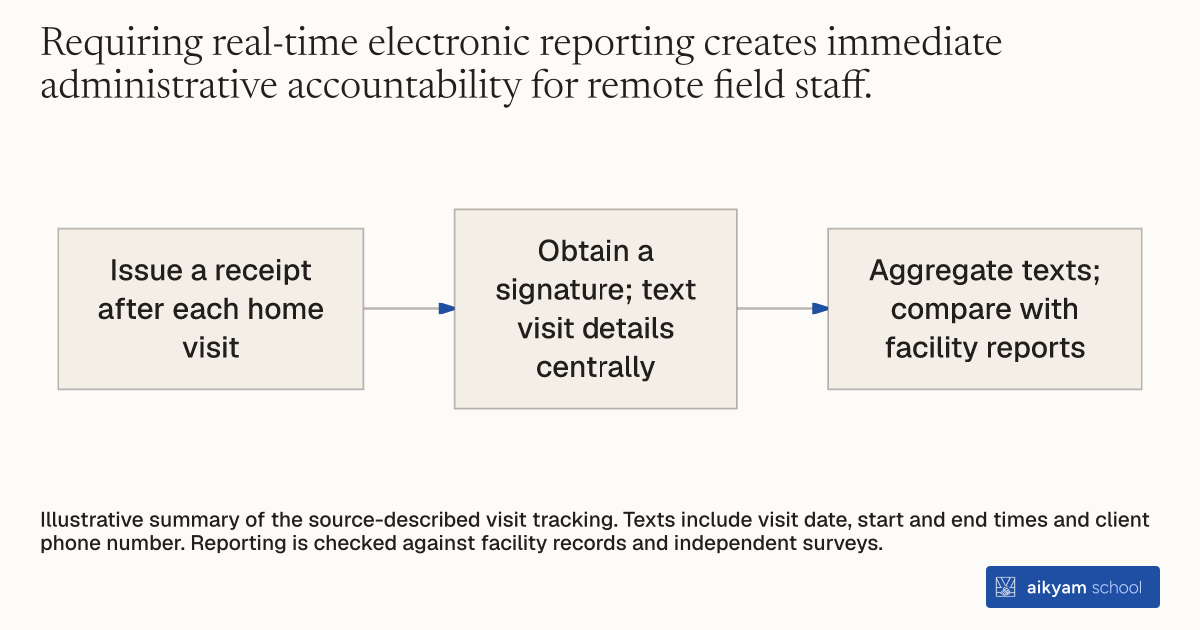
- Issue a receipt after each home visit
- Obtain a signature; text visit details centrally
- Aggregate texts; compare with facility reports
Illustrative summary of the source-described visit tracking. Texts include visit date, start and end times and client phone number. Reporting is checked against facility records and independent surveys.
See source →How
When to use
Public health programs deploying field workers across remote rural communities struggle to monitor daily household service visits. Paper-based reporting is subject to delays, loss, and reporting errors. Real-time mobile text messaging of signed visit receipts creates a continuous administrative dataset to track worker output and verify service delivery.
Track frontline field worker activities by combining physical signed receipt books with real-time text message transmission to a central data facility.
- Ministry administrators equip field health workers with official receipt books before community deployment.
- Health workers issue paper receipts to households at the conclusion of every home visit.
- Health workers request household heads or recipients to sign physical duplicate receipts in the receipt book.
- Health workers transmit visit details—including visit date, start time, end time, and client phone number—via text messages to a central health ministry processing facility.
- Program managers aggregate text message receipts to maintain real-time performance records and validate activity against monthly facility reports.
Why it works
Cross-referencing SMS receipts with household surveys and facility records confirms high reporting fidelity without relying solely on recall.
Example
The Zambian Ministry of Health tracked 307 deployed Community Health Assistants across 48 rural districts over an 18-month period using real-time text message receipts. Health workers logged thousands of home visits, averaging 319 visits per worker in control areas and 412.86 visits in career treatment areas. SMS visit logs correlated strongly with monthly health facility HMIS administrative data (r=0.767) and household survey visit reports.
About the study
Participants
307 deployed Community Health Assistants across 161 health post catchment areas in 48 rural districts in Zambia, validated against surveys of 738 rural households.
Study Design
Cluster-randomized trial evaluating 18 months of individual CHA text message logs validated against administrative HMIS health facility data and independent household surveys.
Results
Real-time SMS visit counts correlated strongly with administrative facility HMIS records (r=0.767, p<0.001) and household survey visit reports (p<0.05). Treatment health workers submitted 93.86 additional SMS visit receipts over 18 months relative to control (319.0 control mean, p=0.030).