Research procedure
Randomise health-product coupon prices
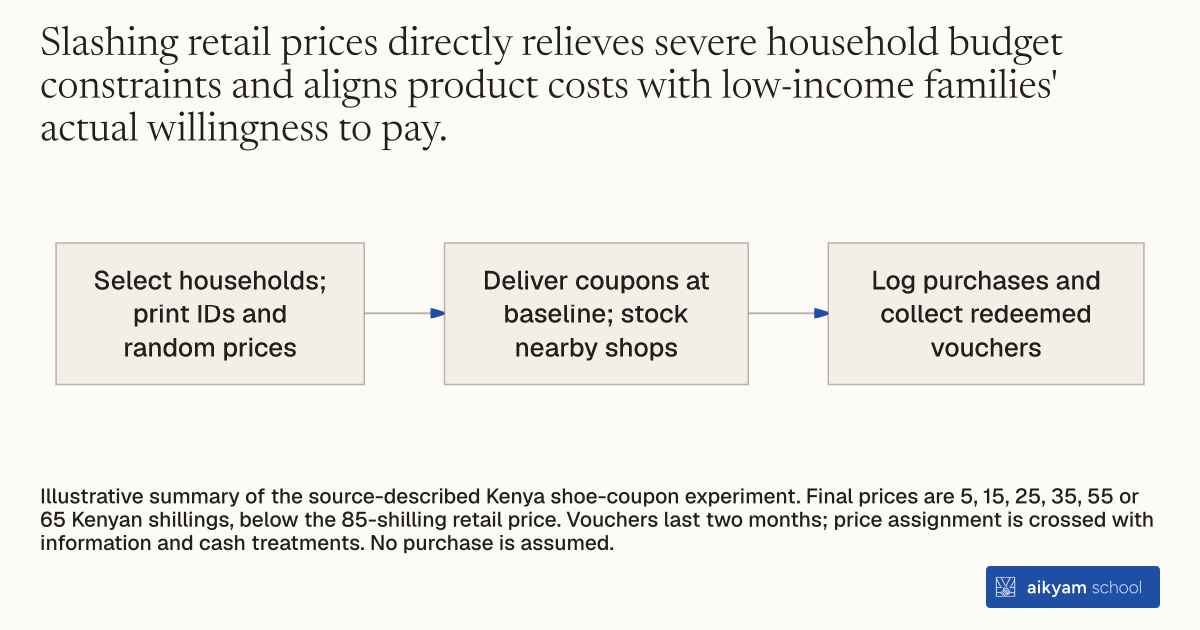
- Select households; print IDs and random prices
- Deliver coupons at baseline; stock nearby shops
- Log purchases and collect redeemed vouchers
Illustrative summary of the source-described Kenya shoe-coupon experiment. Final prices are 5, 15, 25, 35, 55 or 65 Kenyan shillings, below the 85-shilling retail price. Vouchers last two months; price assignment is crossed with information and cash treatments. No purchase is assumed.
See source →How
When to use
Low-income households in developing countries frequently underinvest in high-return preventative health products due to cash constraints and high retail prices. Use this method when launching a health intervention to overcome cost barriers and measure price sensitivity across a target population. It applies to essential items such as children's shoes, water purification products, soap, and dietary supplements.
Distribute randomized discount coupons to targeted households to lower price barriers and increase uptake of essential preventative health products.
- Identify target households through a local census and select eligible participants.
- Generate paper coupons printed with unique household ID numbers and randomized final purchase prices below retail value.
- Deliver coupons directly to households during baseline field visits with a specified redemption time window.
- Partner with nearby local retail shops located within regular shopping distance to hold product inventory.
- Station an officer at the retail shop to log redemptions, record buyer details, and collect redeemed vouchers.
Why it works
Subsidies significantly boost adoption because price variation is the primary driver of preventative health product demand.
Example
In Western Kenya, researchers distributed coupons with randomized discounted prices ranging from 5 to 65 Kenyan shillings for children's rubber shoes retailing at 85 shillings. Redemption rates reached 93% at 5 shillings, 77% at 35 shillings, and dropped to 42% at 65 shillings.
About the study
Participants
999 surveyed households in Busia and Samia Districts of Western Kenya, living on roughly $1 per day with 17% baseline child shoe ownership.
Study Design
Randomized controlled trial offering coupons with random prices (5, 15, 25, 35, 55, or 65 Ksh) valid for 2 months at local shops, cross-cut with information and cash treatments.
Results
Price variation alone explained 78% of purchase decisions; demand dropped from 93% at 5 Ksh to 42% at 65 Ksh, yielding price elasticities between -0.40 and -0.90.