Research steps
Rotate reserved seats across elections
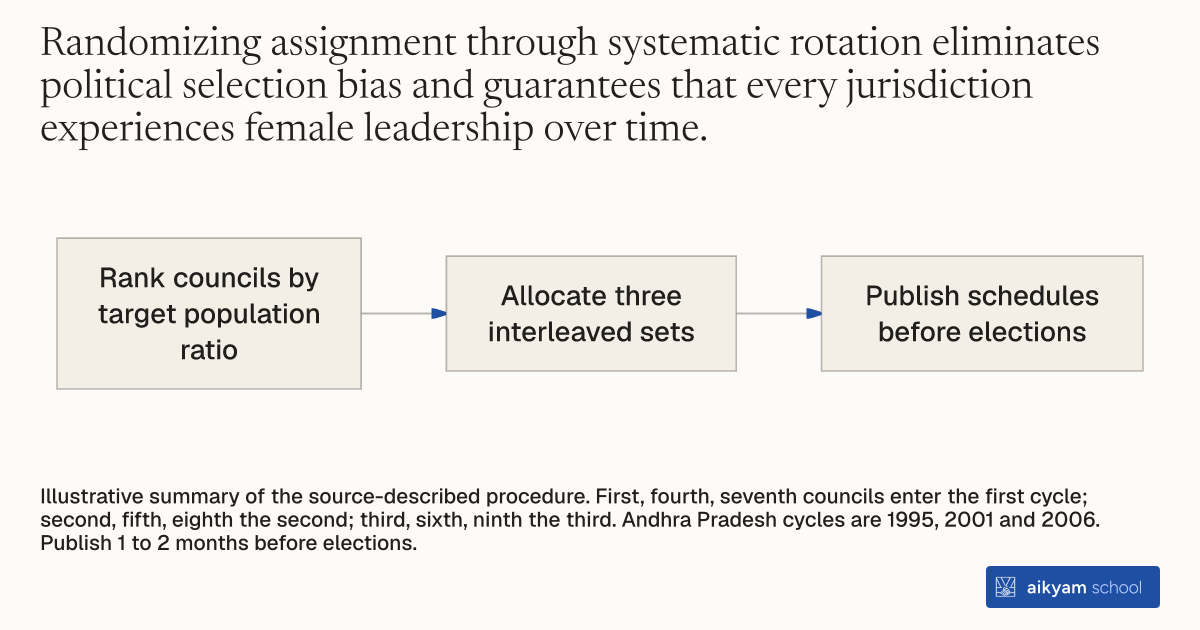
- Rank councils by target population ratio
- Allocate three interleaved sets
- Publish schedules before elections
Illustrative summary of the source-described procedure. First, fourth, seventh councils enter the first cycle; second, fifth, eighth the second; third, sixth, ninth the third. Andhra Pradesh cycles are 1995, 2001 and 2006. Publish 1 to 2 months before elections.
See source →How
When to use
Governments seeking to mandate political representation for underrepresented groups often face accusations of political bias or favoritism when choosing which jurisdictions receive quotas. Rotating leadership quotas systematically and randomly across sequential election cycles ensures fair coverage without political manipulation. This method provides an equitable mechanism for election commissions to mandate female leadership while generating natural policy variation.
Assign female leadership quotas across local village councils using a systematic random rotation rule over successive election cycles.
- List all Gram Panchayats within a district or mandal in descending order of the target population ratio.
- Select every third jurisdiction on the ordered list (the first, fourth, seventh, and so on) to receive mandatory female seat reservation in the first election cycle.
- Assign the second set of jurisdictions (the second, fifth, eighth, and so on) to receive reservation in the second election cycle.
- Assign the remaining set of jurisdictions (the third, sixth, ninth, and so on) to receive reservation in the third election cycle.
- Publish the rotation schedules 1 to 2 months before local elections so all jurisdictions rotate through mandatory reservation over three cycles.
Why it works
Conditional on small population ratio ordering, the timing of quota exposure is statistically exogenous, creating comparable groups across election cohorts.
Example
In Andhra Pradesh, the State Election Commission applied systematic rotation to allocate female sarpanch reservations across Gram Panchayats in 1995, 2001, and 2006. In a sample of 59 rural Gram Panchayats, 20 received reservation in 1995, 12 in 2001, and 27 in 2006, ensuring 100% of councils received one cycle of female leadership by 2006.
About the study
Participants
660 villages across 20 mandals in 6 rural districts of Andhra Pradesh, India, with detailed election reservation data merged for 289 census villages and 59 Young Lives Survey villages.
Study Design
Methodological evaluation comparing baseline 1991 census characteristics across 84 demographic, educational, health, and infrastructure variables between 1995 and 2006 reserved Gram Panchayats.
Results
Villages reserved in 1995 and 2006 showed no significant differences across health, water, or education infrastructure prior to reservation, though 1995 reserved villages had a slightly higher female population ratio (0.501 versus 0.493).