Research allocation
Randomize early and late programme entry
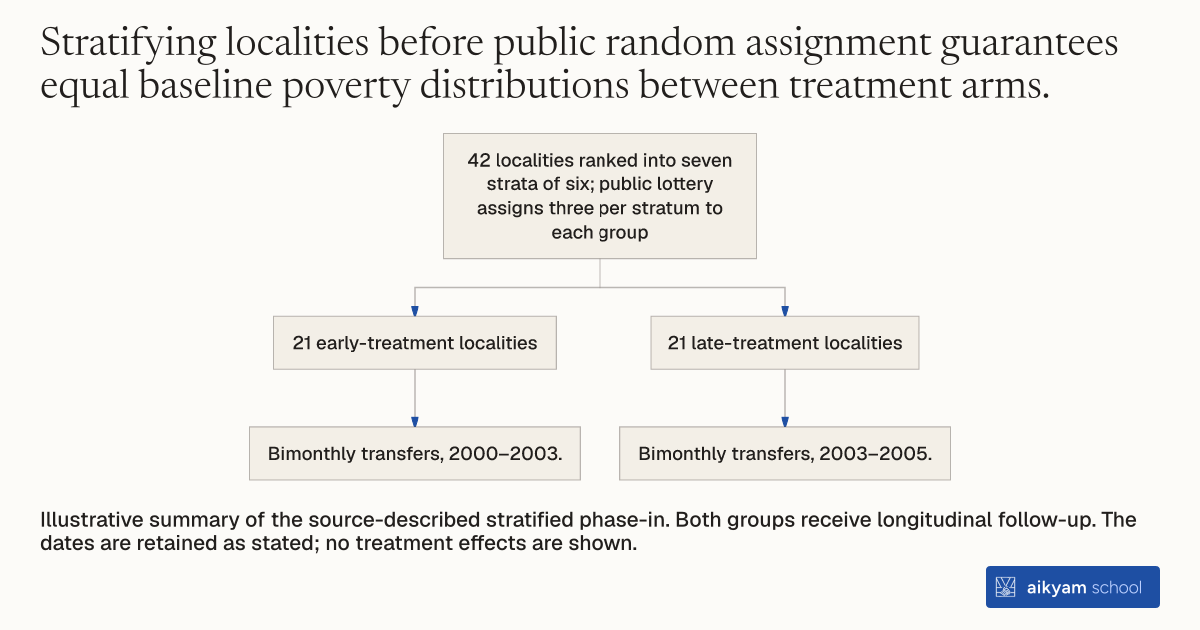
42 localities ranked into seven strata of six; public lottery assigns three per stratum to each group
- 21 early-treatment localities
- Bimonthly transfers, 2000–2003.
- 21 late-treatment localities
- Bimonthly transfers, 2003–2005.
Illustrative summary of the source-described stratified phase-in. Both groups receive longitudinal follow-up. The dates are retained as stated; no treatment effects are shown.
See source →How
When to use
Evaluators face political and ethical challenges when testing social protection programs because denying services permanently to poor communities is infeasible. A randomized phase-in design delivers early benefits to a treatment group while holding a second group as temporary controls before phasing them in. This method provides rigorous experimental evaluation of program exposure timing while ensuring all targeted communities eventually receive benefits.
Evaluate social protection programs by ranking eligible communities into poverty strata and randomly assigning localities to early or late phase-in treatment groups.
- Program evaluators rank all eligible rural localities using a marginality poverty index constructed from census data.
- Program evaluators group the ranked localities into seven strata of six localities each to ensure baseline balance across poverty levels.
- Program administrators hold a public lottery to randomly assign three localities from each stratum to early treatment and three to late treatment.
- Program staff disburse bimonthly conditional cash transfers to early treatment localities for three years from 2000 to 2003.
- Program staff initiate bimonthly conditional cash transfers in late treatment localities for three years from 2003 to 2005.
- Survey teams collect longitudinal survey data across both treatment arms to evaluate differential long-term impacts resulting from timing of exposure.
Why it works
Staggering implementation provides a valid counterfactual control group during the initial phase while maintaining political acceptability by guaranteeing universal rollout.
Example
In central and northern Nicaragua, researchers evaluated the Red de Protección Social CCT program across 42 rural comarcas divided into seven strata of six localities each. Early treatment localities received transfers from 2000 to 2003, while late treatment localities received transfers from 2003 to 2005, enabling 10-year follow-up estimations of differential exposure timing on young women's adult outcomes.
About the study
Participants
42 rural comarcas (21 early treatment, 21 late treatment) containing approximately 250 households each across six municipalities in central and northern Nicaragua.
Study Design
Stratified public lottery randomization assigning 42 localities across seven marginality strata into early (2000–2003) or late (2003–2005) 3-year treatment phase-in groups.
Results
Stratified phase-in achieved balanced baseline characteristics across 52 variables, an 85 percent household take-up rate, and provided experimental identification showing early exposure increased young women's labor market participation by 0.17 standard deviations and reduced fertility by 0.17 standard deviations ten years later.