Research design
Randomise village clusters
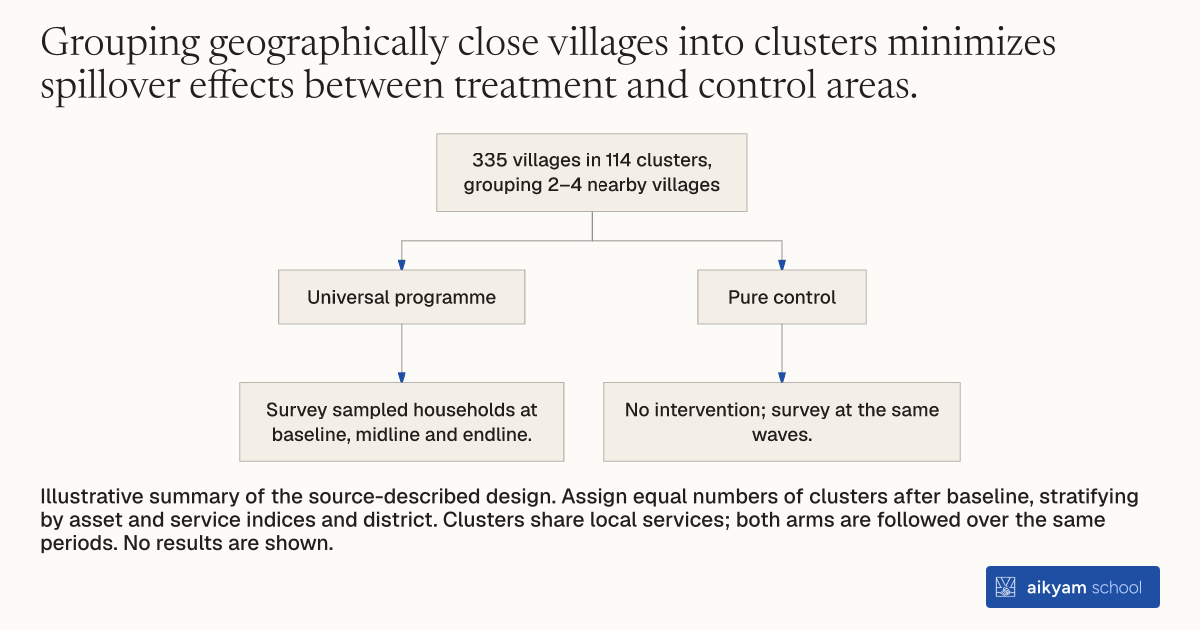
335 villages in 114 clusters, grouping 2–4 nearby villages
- Universal programme
- Survey sampled households at baseline, midline and endline.
- Pure control
- No intervention; survey at the same waves.
Illustrative summary of the source-described design. Assign equal numbers of clusters after baseline, stratifying by asset and service indices and district. Clusters share local services; both arms are followed over the same periods. No results are shown.
See source →How
When to use
Organisations evaluating community-wide anti-poverty interventions need rigorous methods to measure impact without bias from local spillover effects. Traditional household-level randomization risks contamination when untreated neighbours benefit from nearby program activities. This approach uses geographic village clusters to evaluate universal development interventions across rural communities.
Evaluate community-wide programs by randomizing geographically linked village clusters into treatment and control arms using stratified baseline characteristics.
- Group geographically close rural villages that share local services like primary schools, markets, or water sources into multi-village clusters.
- Collect baseline household and village data on wealth, asset ownership, and access to local amenities across all clusters.
- Stratify randomization using median splits on cluster-level asset indices, village service availability indices, and district location.
- Randomly assign equal numbers of clusters to receive the universal program or serve as pure control groups receiving no intervention.
- Survey representative, randomly sampled households in both treatment and control clusters at baseline, midline, and endline intervals.
Why it works
Stratifying clusters on baseline wealth and service availability ensures statistical balance and precise impact estimation across treatment groups.
Example
Researchers evaluated Raising the Village's program across 335 villages in western Uganda by randomizing 114 clusters of 2–4 villages into treatment and control groups, finding that monthly household income increased by USD 40.703 PPP.
About the study
Participants
3,852 households across 335 villages in Kagadi and Kyenjojo districts, western Uganda, where 35% of households fall below the \$2.15 PPP daily poverty line post-harvest and 65% during the lean season.
Study Design
Clustered randomized controlled trial across 114 village clusters covering 335 villages, comparing a universal livelihoods program to a pure control group.
Results
Monthly household income increased by USD 40.703 PPP (26%, p < 0.01), non-land wealth increased by USD 389.518 PPP (31%, p < 0.01), and monthly consumption increased by USD 58.807 PPP (10%, p < 0.01).