Research procedure
Balance village treatment assignments
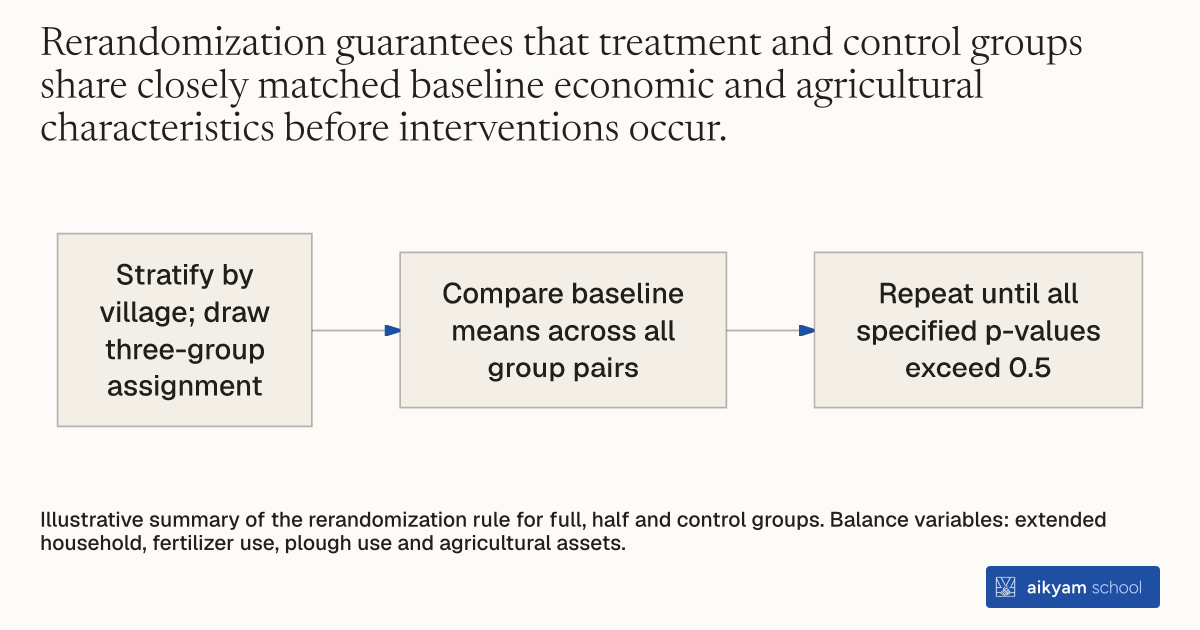
- Stratify by village; draw three-group assignment
- Compare baseline means across all group pairs
- Repeat until all specified p-values exceed 0.5
Illustrative summary of the rerandomization rule for full, half and control groups. Balance variables: extended household, fertilizer use, plough use and agricultural assets.
See source →How
When to use
Use this method when assigning experimental units to multiple treatment arms across clusters while ensuring baseline balance on key covariates. It solves the problem of accidental baseline imbalances across small sample sizes. It is designed for researchers structuring field experiments across rural communities.
Execute a stratified rerandomization algorithm that checks mean comparisons across baseline variables until balance criteria are satisfied.
- Group study participants into geographical village clusters to stratify assignment.
- Select key baseline balance variables including extended household status, baseline fertilizer usage, plow usage, and an agricultural asset index.
- Draw candidate random assignments of participants to treatment cells.
- Calculate pairwise p-values comparing group means for all selected baseline variables across every treatment group pairing.
- Re-run candidate random draws iteratively until the p-values for comparisons of means between any of the three groups exceed 0.5 for all balance variables.
Why it works
This minimizes baseline noise and prevents accidental confounding from unmeasured assignment skew.
Example
Researchers assigned 383 Malian female rice farmers across 23 villages into full treatment, half treatment, and control groups. The rerandomization algorithm ensured p-values exceeded 0.5 across all balance variables between all three groups.
About the study
Participants
383 female rice farmers across 23 villages in Bougouni district, southern Mali.
Study Design
Rerandomization routine stratifying by village across 3 groups enforcing balance on 4 key baseline variables.
Results
Baseline mean comparisons across 9 key input and outcome variables yielded zero statistically significant differences at the 10 percent level across groups, achieving p-values above 0.5 for all stratified balance variables.