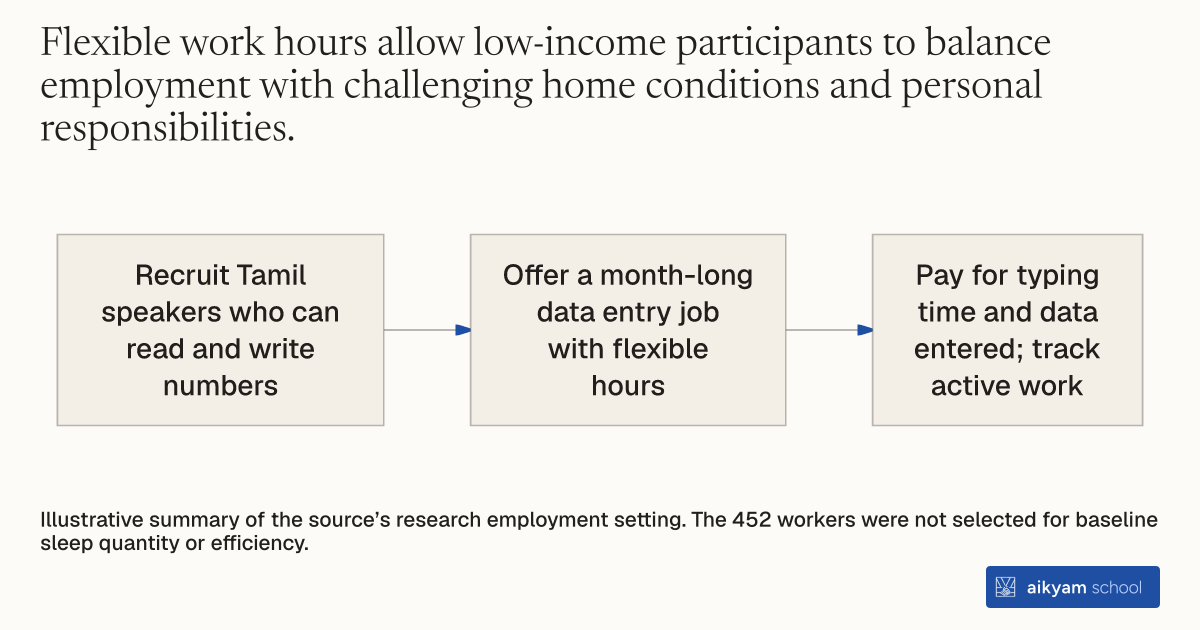
Research procedure
Recruit workers and track output
- Recruit Tamil speakers who can read and write numbers
- Offer a month-long data entry job with flexible hours
- Pay for typing time and data entered; track active work
Illustrative summary of the source’s research employment setting. The 452 workers were not selected for baseline sleep quantity or efficiency.
See source →How
When to use
Low-income urban workers face limited opportunities for flexible paid work that accommodates varying schedules. Recruiting these workers for structured data entry jobs helps organizations assess labor supply and earnings. This method serves researchers and recruiters seeking to measure worker performance in low-income urban communities.
Recruit and manage low-income workers for a flexible data entry position to measure daily labor output and earnings.
- Recruit men and women from low-income neighborhoods in Chennai who can read and write numbers and speak Tamil.
- Enroll participants without selecting them for baseline sleep quantity or sleep efficiency.
- Provide a month-long full-time data entry job with flexible working hours.
- Pay workers based on time spent typing and the amount of data entered.
- Measure active labor supply continuously through typing time while accounting for short breaks.
Why it works
Direct output-based pay combined with active time tracking aligns financial incentives with measurable effort.
Example
Researchers hired 452 men and women from low-income neighborhoods in Chennai, India, for a one-month data entry job with flexible hours, where workers earned pay based on typing time and data entered.
About the study
Participants
452 men and women from low-income neighborhoods in Chennai, India, with an average of 10 years of education and 1 to 2 children.
Study Design
A randomized evaluation conducted over a one-month data entry job with flexible hours, measuring active typing time, output, and earnings.
Results
Baseline participants spent 8 hours per night in bed but slept only 5.6 hours on average, yielding a sleep efficiency far below standard levels.