In Simple Words
Imagine a commuter train that departs at exactly 8:00 AM every morning with no exceptions. If a passenger must drop off a child at school at 8:05 AM, she can never board the train and is forced to take an unsafe hitchhike. Adding flexible boarding times allows her to ride the official train without abandoning her family responsibilities.
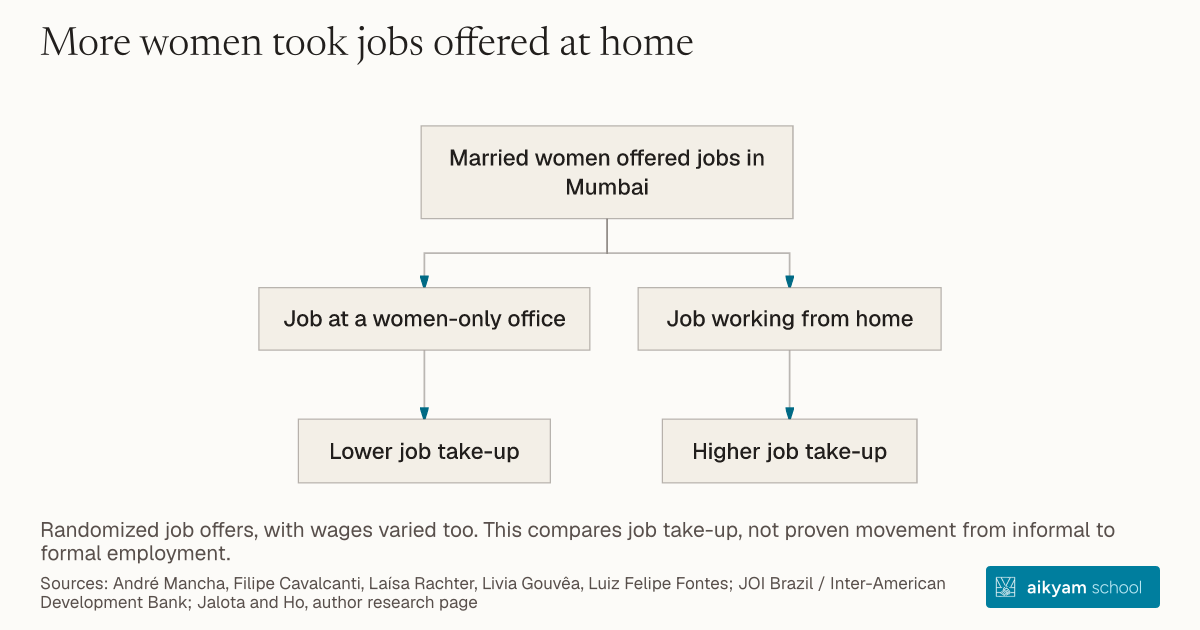
Married women offered jobs in Mumbai
- Job at a women-only office
- Lower job take-up
- Job working from home
- Higher job take-up
Randomized job offers, with wages varied too. This compares job take-up, not proven movement from informal to formal employment.
See source →Study conditions — Jalota and Ho, author research page ↗Research question
Rigid formal working hours force women with domestic care obligations into informal jobs, exacerbating female labor market vulnerability and gender income gaps.
Participants
Female job seekers and working mothers in Colombia (Bustelo et al., 2020) and urban women in India (Ho et al., 2024; Jalota and Ho, 2024).
Study Design
Willingness-to-pay discrete choice experiment and field experiment RCTs.
Results
Women were willing to forgo higher wages in exchange for job schedule flexibility, and providing remote/flexible formal work arrangements led to significant increases in female labor force participation.
Takeaway
Legally define flexible working hour arrangements and remote option clauses within formal employment contracts to retain female workers.
Source and citation
See source →Evidence in Labor Market Policies and Implications for Brazil: Informality
Copyright © 2025 Inter-American Development Bank.
Full source notice
Copyright © 2025 Inter-American Development Bank ("IDB"). This work is subject to a Creative Commons license CC BY 3.0 IGO (https://creativecommons.org/licenses/by/3.0/igo/legalcode). The terms and conditions indicated in the URL link must be met and the respective recognition must be granted to the IDB. Further to section 8 of the above license, any mediation relating to disputes arising under such license shall be conducted in accordance with the WIPO Mediation Rules. Any dispute related to the use of the works of the IDB that cannot be settled amicably shall be submitted to arbitration pursuant to the United Nations Commission on International Trade Law (UNCITRAL) rules. The use of the IDB's name for any purpose other than for attribution, and the use of IDB's logo shall be subject to a separate written license agreement between the IDB and the user and is not authorized as part of this license. Note that the URL link includes terms and conditions that are an integral part of this license.