Try, learn and adjust
Check community mentors receive training and support
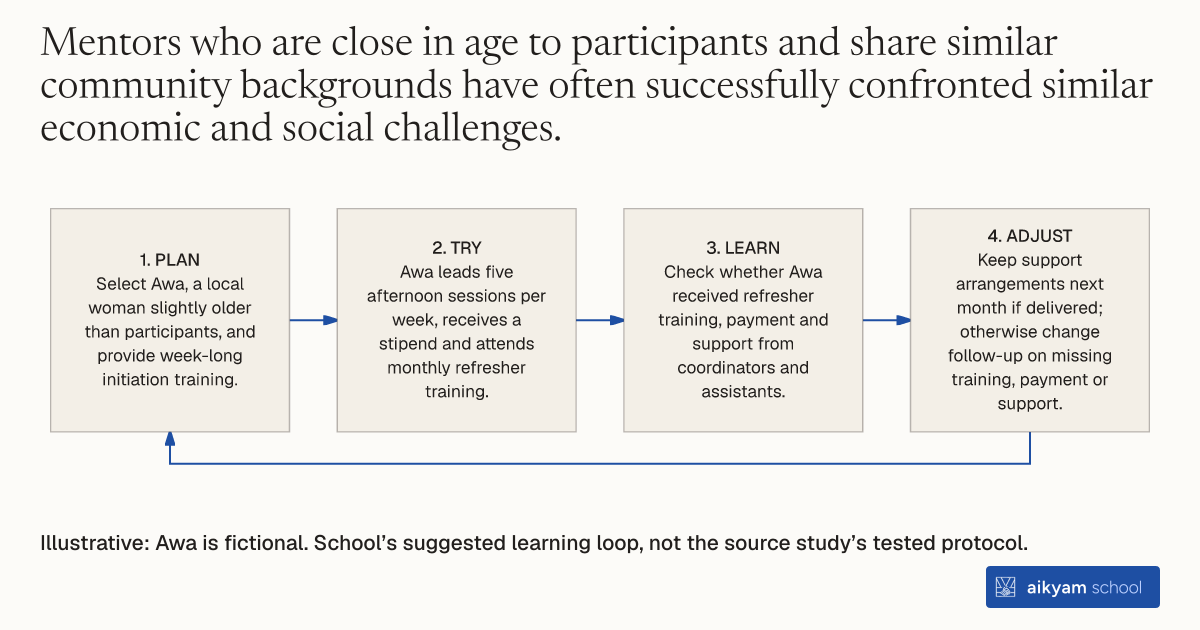
- Plan: Select Awa, a local woman slightly older than participants, and provide week-long initiation training.
- Try: Awa leads five afternoon sessions per week, receives a stipend and attends monthly refresher training.
- Learn: Check whether Awa received refresher training, payment and support from coordinators and assistants.
- Adjust: Keep support arrangements next month if delivered; otherwise change follow-up on missing training, payment or support.
Illustrative: Awa is fictional. School’s suggested learning loop, not the source study’s tested protocol.
See source →School’s suggested, untested learning loop. Observe mentor preparation and ongoing support; do not infer participant outcomes from this check.
How
When to use
Adolescent girls in developing countries often hesitate to discuss sensitive health, social, and economic issues with authority figures or teachers. Standard school-based social empowerment interventions can fail because youth feel uncomfortable opening up. Recruit local female mentors who are slightly older than participants to facilitate peer-to-peer knowledge transfer and club delivery.
Hire and train local female mentors to lead adolescent development club activities and deliver life skills education.
- Program managers select female mentors from within the target community who are slightly older than the target girl population.
- Program trainers provide new mentors with a week-long initiation training program before club activities begin.
- Program trainers conduct monthly refresher training courses for mentors to reinforce delivery techniques and topics.
- Program managers pay mentors small lump-sum stipends to compensate them for leading five afternoon sessions per week.
- Program staff provide ongoing operational support through branch coordinators and program assistants.
Why it works
This near-peer relationship makes adolescent girls comfortable discussing sensitive reproductive health, sexual, and personal topics that they would not discuss with teachers.
Example
BRAC recruited and trained 100 female adolescent leaders across 100 community clubs in Uganda. Each mentor received a week-long initiation training, monthly refresher courses, and annual stipend compensation of $144 per club ($12 per month). This community-based staffing structure supported 100 clubs serving thousands of adolescent girls across rural and urban communities.
About the study
Participants
4,888 adolescent girls tracked at midline and 3,522 at endline across 150 communities in Kampala, Mukono, Iganga, and Jinja, Uganda, with average baseline age of 16.3 years.
Study Design
Cluster randomized control trial across 150 communities (100 treatment, 50 control) stratified by 10 branch offices, evaluating outcomes at baseline, midline (2 years), and endline (4 years) using OLS ANCOVA and Lee bounds.
Results
Four years post-intervention, engagement in income-generating activities increased by 48%, self-employment rates rose by 50%, teen pregnancy fell by 34%, early marriage/cohabitation dropped by 62%, and reporting sex against will decreased by 31%.