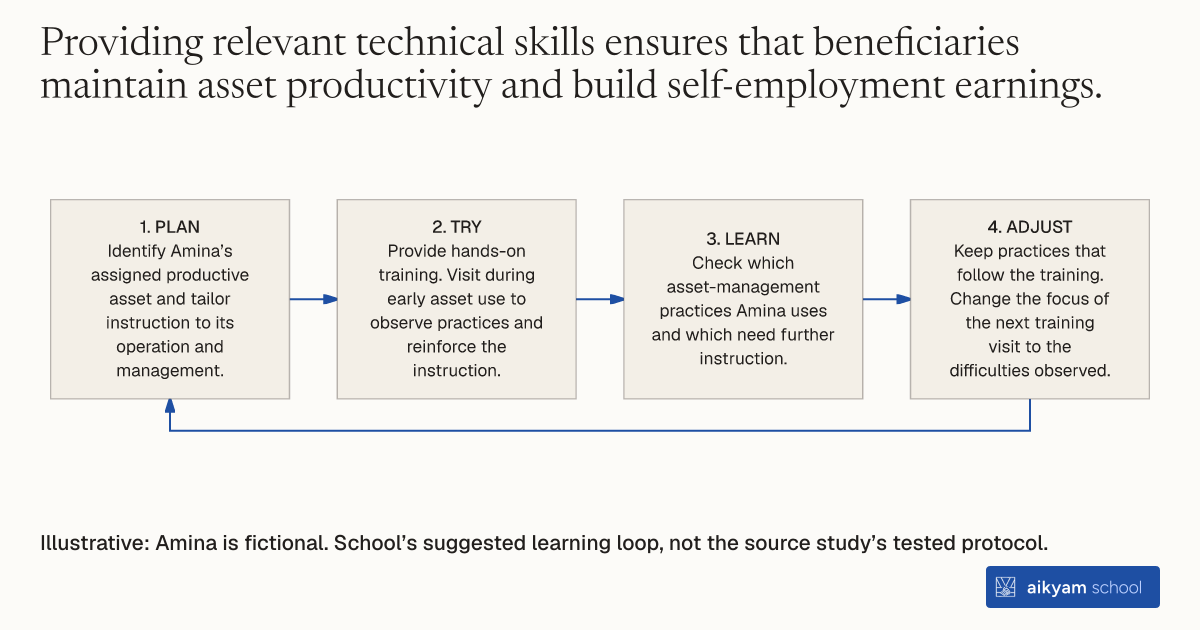
Try, learn and adjust
Check asset training matches household practices
- Plan: Identify Amina’s assigned productive asset and tailor instruction to its operation and management.
- Try: Provide hands-on training. Visit during early asset use to observe practices and reinforce the instruction.
- Learn: Check which asset-management practices Amina uses and which need further instruction.
- Adjust: Keep practices that follow the training. Change the focus of the next training visit to the difficulties observed.
Illustrative: Amina is fictional. School’s suggested learning loop, not the source study’s tested protocol.
See source →School’s suggested learning loop: observe asset-management practices; the source’s income gains came from a bundled intervention, not training alone.
How
When to use
Low-income households in extreme poverty often lack the practical knowledge needed to operate a business or maintain capital goods effectively. Without specialized instruction, transferred assets like livestock or merchandise may be mismanaged or lost. Provide tailored technical training to ensure beneficiaries can successfully manage their productive assets.
Deliver targeted technical skills training to ultra-poor households receiving productive assets.
- Program planners evaluate the specific asset type assigned to each household.
- Technical trainers design customized instruction modules covering proper asset operation and enterprise management.
- Instructional staff deliver hands-on training sessions to teach participants asset management skills.
- Field workers observe beneficiary practices during early asset deployment to reinforce training principles.
Why it works
Coupling technical knowledge with capital assets prevents asset loss and supports sustainable income generation.
Example
In a six-country study across diverse sites, beneficiaries who received asset-specific training as part of a bundled intervention achieved income gains between 7 and 65 percent.