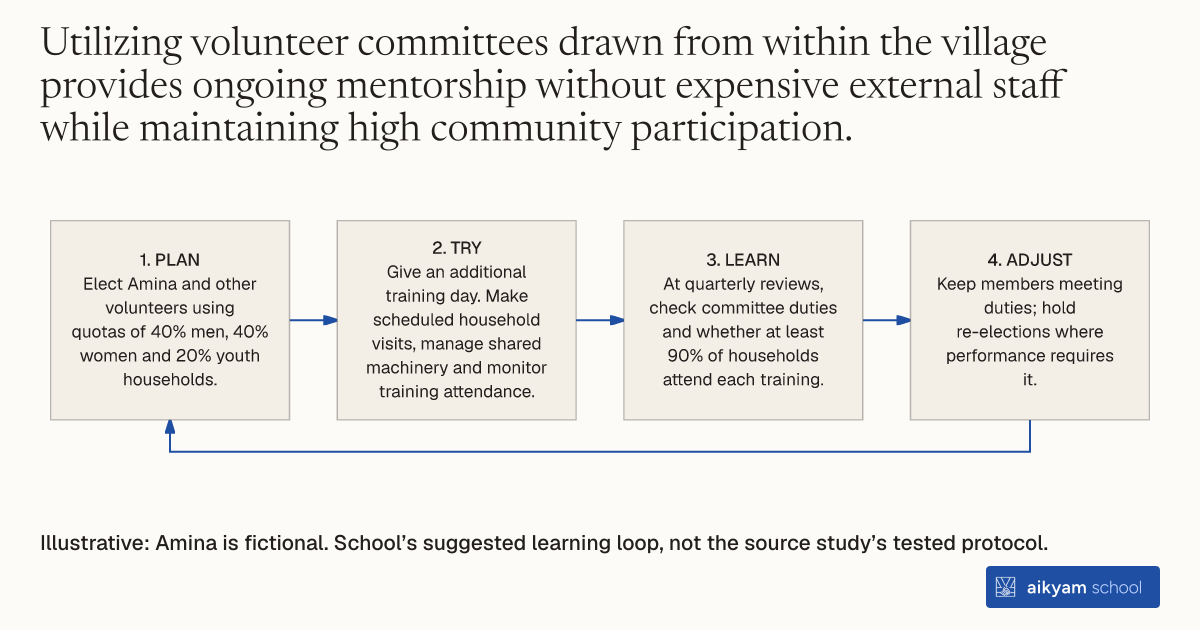
Try, learn and adjust
Check agriculture committee support
- Plan: Elect Amina and other volunteers using quotas of 40% men, 40% women and 20% youth households.
- Try: Give an additional training day. Make scheduled household visits, manage shared machinery and monitor training attendance.
- Learn: At quarterly reviews, check committee duties and whether at least 90% of households attend each training.
- Adjust: Keep members meeting duties; hold re-elections where performance requires it.
Illustrative: Amina is fictional. School’s suggested learning loop, not the source study’s tested protocol.
See source →School’s suggested loop, not a tested source procedure. Observe attendance, check-ins and machinery management; do not infer farm sales gains from these checks.
How
When to use
Rural agricultural development programs often struggle with low training attendance, poor technique adoption, and improper management of shared farm equipment. Establishing an elected, community-based volunteer committee creates local governance and peer-to-peer mentorship. This approach is intended for farming villages undergoing community-wide agricultural extension programs.
Establish an elected village agriculture committee to manage shared farm inputs and mentor households in adopting agricultural techniques.
- Elect committee members from village volunteers using demographic quotas of 40% men, 40% women, and 20% youth households.
- Provide committee members with an additional day of specialized training focused on leadership, mentorship, and agricultural techniques.
- Conduct regular household check-ins across the village on a fixed schedule to support adoption of taught farming practices.
- Monitor and ensure that at least 90% of village households attend each agricultural training session.
- Manage communal agricultural inputs and machinery, including coffee pulpers and milling machines, for all village households.
- Undergo quarterly check-ins by project officers to evaluate committee performance and hold re-elections if necessary.
Why it works
Peer-led check-ins reinforce training compliance and ensure equal access to shared village machinery.
Example
In rural western Uganda, Raising the Village formed elected agriculture committees across treated villages, where volunteer members spent approximately 155 hours over two years providing peer coaching, maintaining over 90% training attendance, and helping increase monthly farm sales by USD 21.46 PPP.
About the study
Participants
3,852 households across 335 villages in Kagadi and Kyenjojo districts, western Uganda, where 35% of households fall below the \$2.15 PPP daily poverty line post-harvest and 65% during the lean season.
Study Design
Clustered randomized controlled trial across 114 village clusters covering 335 villages, comparing a universal livelihoods program to a pure control group.
Results
Training attendance exceeded 90% across treated households (with 84% completing all four training types), crop sales increased by 27% (USD 21.46 PPP per month, p < 0.01), and non-land wealth rose by USD 389.52 PPP (31%, p < 0.01).