Research design
Survey referrers while candidates test
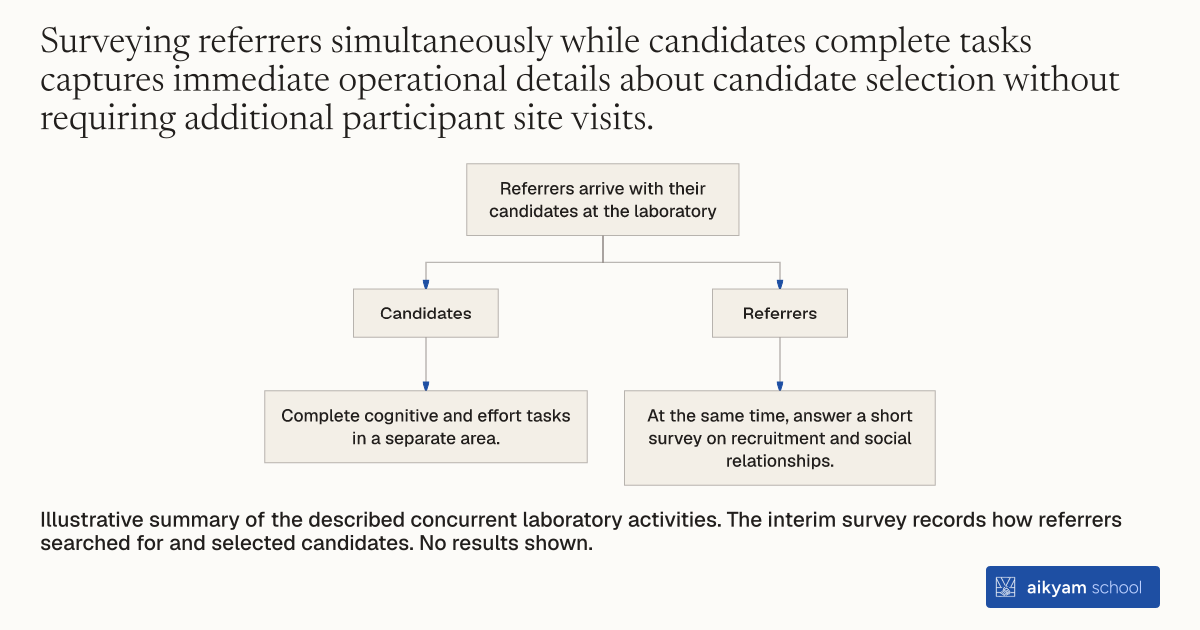
Referrers arrive with their candidates at the laboratory
- Candidates
- Complete cognitive and effort tasks in a separate area.
- Referrers
- At the same time, answer a short survey on recruitment and social relationships.
Illustrative summary of the described concurrent laboratory activities. The interim survey records how referrers searched for and selected candidates. No results shown.
See source →How
When to use
Employers and researchers often lack visibility into how workers choose whom to refer for job openings. This method gathers data on the search and decision-making process referrers undergo when selecting candidates. It helps program managers evaluate how recruitment incentives influence referral behavior.
Administer an interim survey to referrers while their candidates complete job assessments to capture referral decision-making data.
- Receive original worker referrers alongside their brought candidate referrals at the laboratory site.
- Direct referred candidates to separate testing areas to perform cognitive and effort tasks.
- Administer a short interim survey to the referrers while candidates are performing tasks.
- Record survey responses regarding recruitment steps, candidate search strategies, and social relationship dynamics.
Example
Researchers in Kolkata, India surveyed original participants while their 407 referred candidates completed cognitive quilt tasks, gathering data on candidate recruitment decisions across 5 payment contract treatments.
About the study
Participants
562 original participants and 407 referrals (adult males aged 18 to 60) in Kolkata, India.
Study Design
Interim survey administered to original participants in a laboratory RCT while referrals performed cognitive and effort tasks.
Results
Interim survey data revealed that high performance pay incentives decreased relative referrals by 7 percentage points and increased coworker referrals by 8 percentage points.