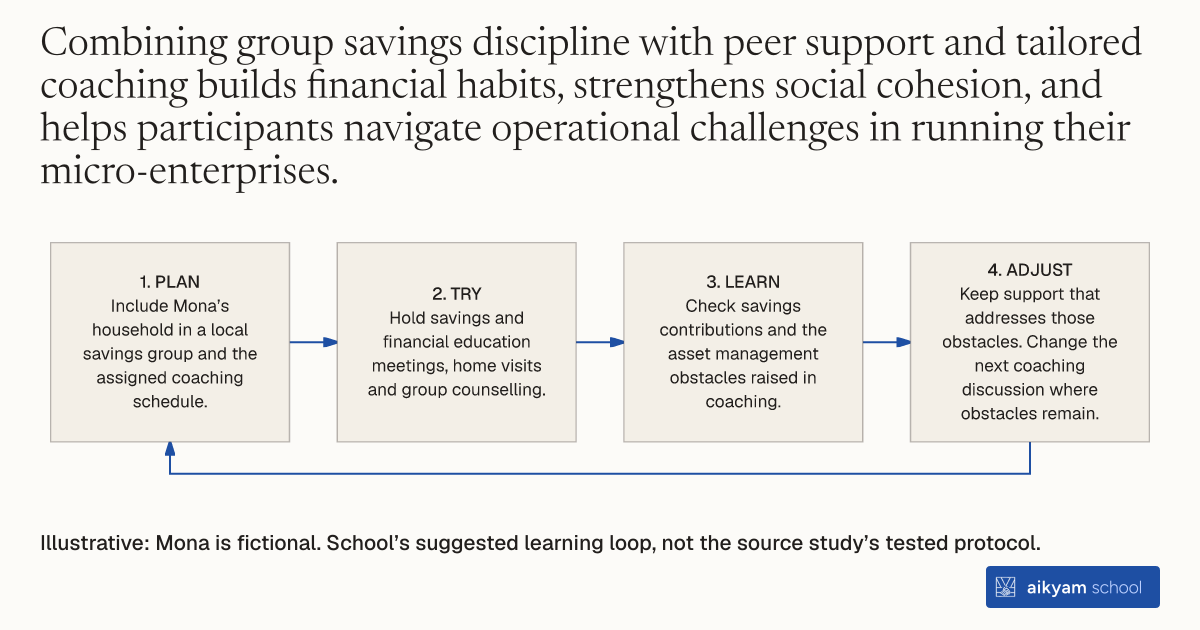
Try, learn and adjust
Check savings meetings and home coaching
- Plan: Include Mona’s household in a local savings group and the assigned coaching schedule.
- Try: Hold savings and financial education meetings, home visits and group counselling.
- Learn: Check savings contributions and the asset management obstacles raised in coaching.
- Adjust: Keep support that addresses those obstacles. Change the next coaching discussion where obstacles remain.
Illustrative: Mona is fictional. School’s suggested learning loop, not the source study’s tested protocol.
See source →School’s suggested learning loop, not the source’s tested procedure. Observe savings contributions and coaching concerns. Follow assigned full or half frequency; this loop does not isolate a component’s effect.
How
When to use
Ultra-poor households often lack financial literacy, structured savings habits, and personal guidance needed to manage micro-enterprises. Regular group interaction and coaching provide ongoing support and accountability. This method serves ultra-poor rural families participating in graduation programs.
Organize regular savings group meetings and individualized home coaching visits for program participants.
- Form local participant groups among ultra-poor households in rural targeted villages.
- Schedule regular savings group meetings where members contribute savings and receive financial education.
- Conduct coaching home visits to provide individual guidance on asset management, health education, and life skills.
- Facilitate group counseling sessions to address social and economic obstacles faced by participants.
- In the half-cost variant, reduce the frequency of coaching visits and savings group meetings by half as specified by the program design.
Example
In Assiut and Sohag governorates, local NGO partners conducted regular savings group meetings and coaching home visits across 3,465 participating ultra-poor households. In the full-cost arms, full meeting frequency was maintained, whereas the half-cost arm tested halving meeting and visit frequency.
About the study
Participants
3,465 ultra-poor households in rural villages of Assiut and Sohag governorates, Upper Egypt.
Study Design
Randomized controlled trial comparing full-cost arms (full coaching and meeting frequency) and half-cost arm (half coaching and meeting frequency) against control over 20-month and 40-month follow-ups.
Results
Halving the frequency of coaching visits and savings group meetings (alongside halving asset value) yielded about half the effect on total monthly income (EGP 3,083 vs EGP 3,074 and EGP 2,949 in full-cost arms) and monthly total expenditure (EGP 4,448 vs EGP 4,509 and EGP 4,520) at 40-month endline.