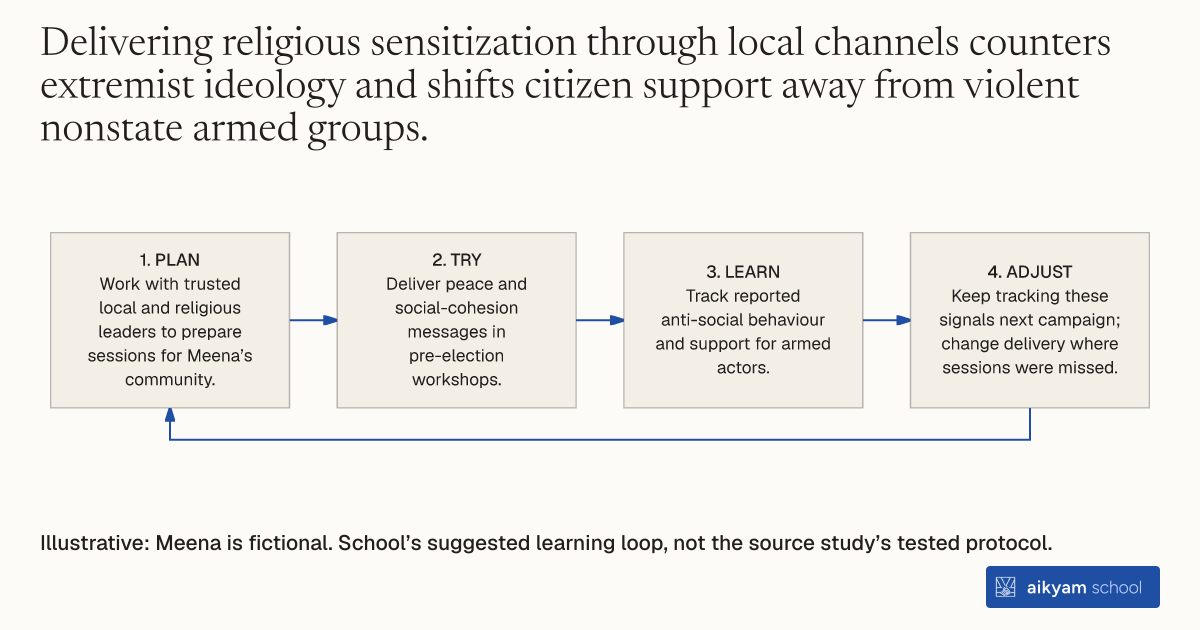
Try, learn and adjust
Check peace messages reach the community
- Plan: Work with trusted local and religious leaders to prepare sessions for Meena’s community.
- Try: Deliver peace and social-cohesion messages in pre-election workshops.
- Learn: Track reported anti-social behaviour and support for armed actors.
- Adjust: Keep tracking these signals next campaign; change delivery where sessions were missed.
Illustrative: Meena is fictional. School’s suggested learning loop, not the source study’s tested protocol.
See source →Session delivery, reported anti-social behaviour and support for armed actors. School’s suggested learning loop, not a source-tested cycle.
How
When to use
Nonstate armed groups and extremist factions use violence to influence elections and intimidate voters. Civil society and community leaders seek ways to shift citizen support away from violent groups. This method helps organizations reduce sympathy and backing for extremist actors during electoral periods.
Conduct religious sensitization campaigns in communities to shift citizens' support away from nonstate armed groups.
- Partner with trusted local leaders and religious communicators in targeted communities.
- Develop educational materials and messages focused on religious values of peace and social cohesion.
- Conduct community workshops and public sensitization sessions ahead of elections.
- Address radicalization risks by promoting peaceful civic behavior and counter-extremist messaging.
- Track changes in community anti-social behavior and support for armed actors.
Example
In a study cited in the review, researchers evaluated a religious sensitization campaign designed to prevent Islamic radicalization and reduce anti-social behavior in targeted communities.
About the study
Participants
Citizens and communities exposed to extremist nonstate armed group influence.
Study Design
Randomized field experiment evaluating a religious sensitization campaign against unexposed control communities.
Results
Shifted citizens' support away from nonstate armed groups and reduced anti-social behavior.