Research analysis
Model choices across energy sources
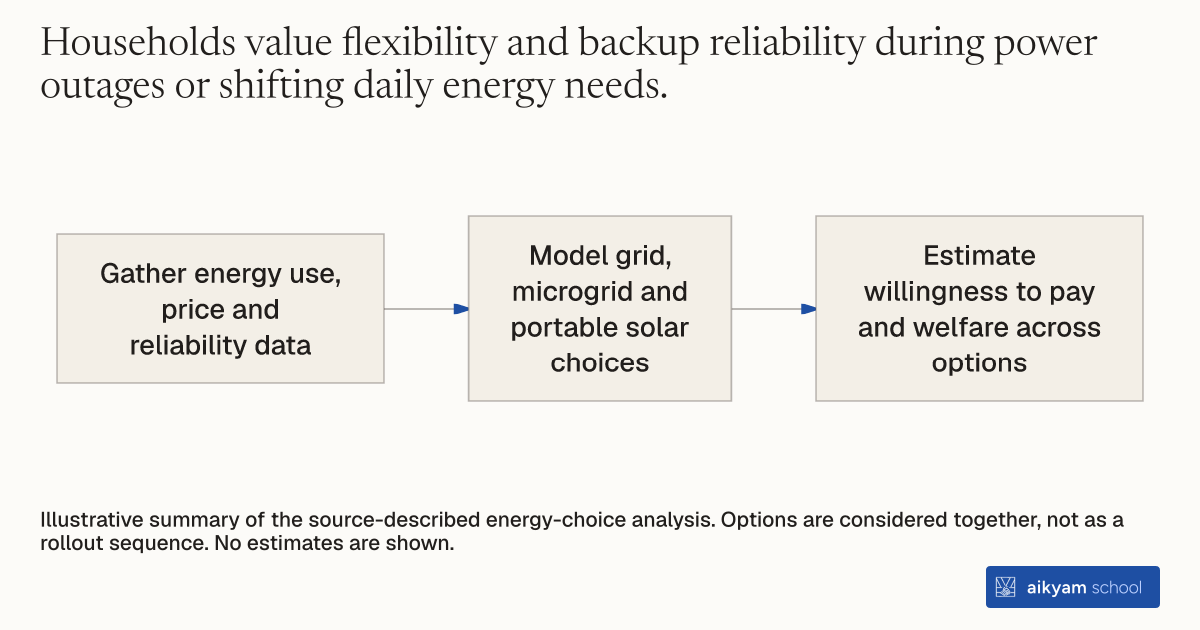
- Gather energy use, price and reliability data
- Model grid, microgrid and portable solar choices
- Estimate willingness to pay and welfare across options
Illustrative summary of the source-described energy-choice analysis. Options are considered together, not as a rollout sequence. No estimates are shown.
See source →How
When to use
Standard evaluations analyze energy technologies in isolation without accounting for how families combine power options. Researchers model consumer demand across all available energy sources simultaneously. This method measures the true economic value of providing choices to rural households.
Model household demand across all available energy sources to evaluate consumer choice and total economic value.
- Survey teams gather data on household energy usage, prices, and power reliability across grid and solar options.
- Economists build a structural demand model comparing choices between grid connections, microgrids, and portable solar products.
- Analysts calculate household willingness to pay for individual energy options and full energy portfolios.
- Policy teams evaluate welfare gains from offering multiple energy choices compared to single-source options.
Why it works
Access to multiple energy options provides higher utility than relying on a single power system.
Example
In Uttar Pradesh and Bihar, India, researchers modeled household choices between grid access and subsidized solar microgrids, finding families valued having options more than any single power source.
About the study
Participants
Unconnected rural households in Uttar Pradesh and Bihar, India.
Study Design
Structural demand modeling combined with a randomized trial evaluating subsidized solar microgrid access during national grid rollout.
Results
Modeling household value across all electricity sources showed that families valued having a choice between multiple energy sources more than any single source alone.