Research steps
Value clean water through source choices
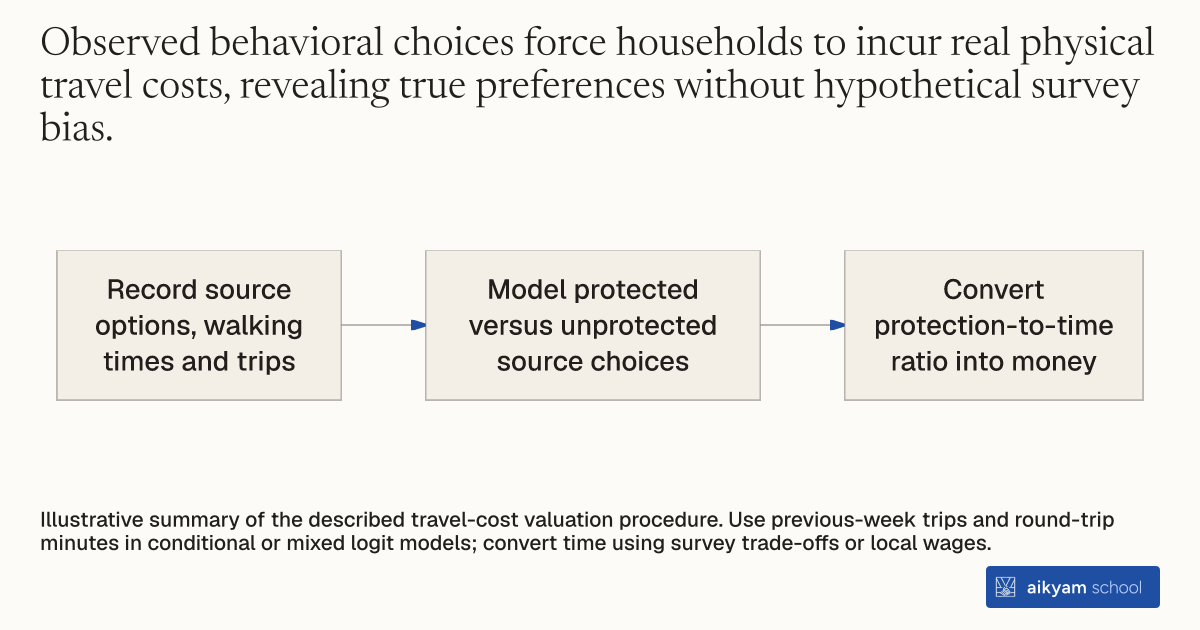
- Record source options, walking times and trips
- Model protected versus unprotected source choices
- Convert protection-to-time ratio into money
Illustrative summary of the described travel-cost valuation procedure. Use previous-week trips and round-trip minutes in conditional or mixed logit models; convert time using survey trade-offs or local wages.
See source →How
When to use
When evaluating public amenities in rural settings, formal markets and user fees rarely exist. Evaluators need an objective method to measure how much local households value environmental improvements such as clean drinking water. Modeling household choices between competing water sources based on walking travel time reveals their true economic valuation.
Estimate household willingness to pay for clean water by modeling travel time trade-offs across available water source choices.
- Survey enumerators record all potential water source options available to each household and the round-trip walking distance in minutes to each source.
- Enumerators record household water collection choices across all collection trips made during the previous week.
- Econometricians estimate a conditional logit or mixed logit model comparing the choice of protected versus unprotected water sources against walking travel time.
- Econometricians calculate the ratio of the spring protection coefficient to the walking time coefficient to establish protection valuation in terms of walking time.
- Econometricians convert walking time valuation into monetary value using household survey data on time-money trade-offs or local casual labor wages.
Why it works
Trading off extra walking time against superior water quality identifies the exact marginal cost households willingly bear for cleaner water.
Example
In rural western Kenya, researchers modeled water source choices across 1,354 households using a mixed logit travel cost framework, finding that households value one year of spring protection at 32.4 work days, equivalent to a mean annual valuation of 2.96 US dollars per household.
About the study
Participants
1,354 households across 184 spring communities in Busia and Butere-Mumias districts, Kenya.
Study Design
Revealed preference travel cost framework using conditional and mixed logit specifications applied to weekly household water trip logs and walking distances.
Results
Mixed logit estimates revealed an annual household valuation of 32.4 work days ($2.96 USD) for spring protection, an upper bound WTP of $0.89 to avert one child diarrhea case, and an upper bound value of statistical child life of $769 ($23.68 per DALY averted).