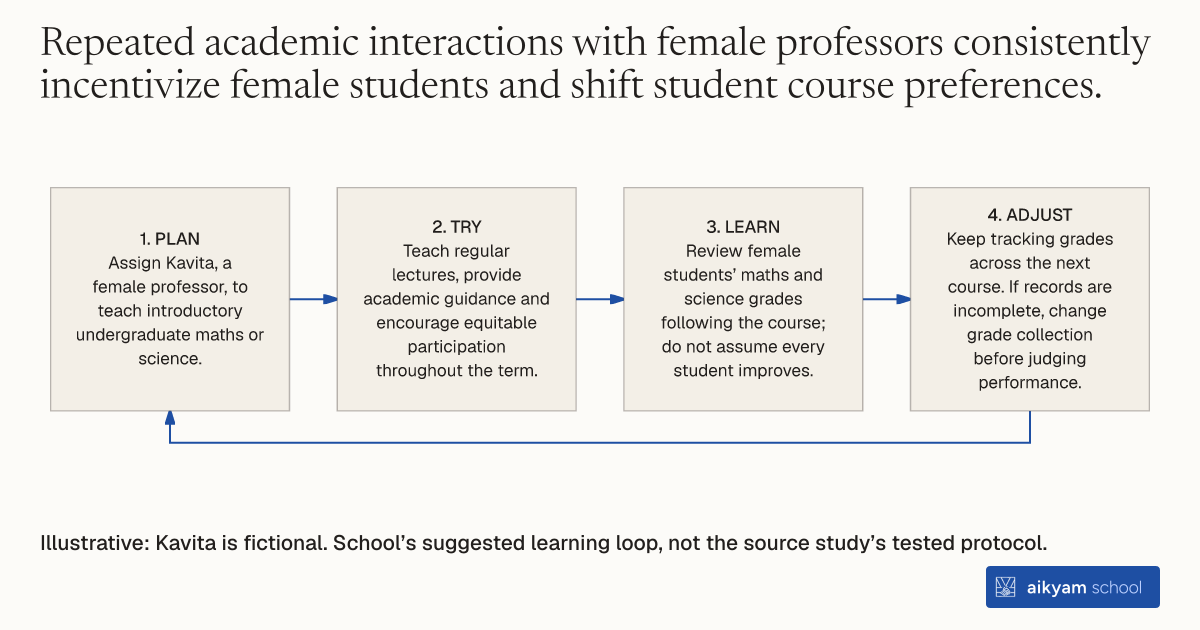
Try, learn and adjust
Check introductory teaching and student performance
- Plan: Assign Kavita, a female professor, to teach introductory undergraduate maths or science.
- Try: Teach regular lectures, provide academic guidance and encourage equitable participation throughout the term.
- Learn: Review female students’ maths and science grades following the course; do not assume every student improves.
- Adjust: Keep tracking grades across the next course. If records are incomplete, change grade collection before judging performance.
Illustrative: Kavita is fictional. School’s suggested learning loop, not the source study’s tested protocol.
See source →School’s suggested learning loop: observe course grades; the source’s randomized evaluation, not this loop, tested professor gender.
How
When to use
Female college students often experience lower academic performance and higher attrition in male-dominated STEM fields. This gap in performance and retention reduces female representation in technical careers. Assign female professors to teach introductory undergraduate math and science courses.
Assign female faculty members to teach introductory STEM college courses.
- Assign female professors to instruct introductory math and science undergraduate courses.
- Conduct regular classroom lectures and instructional interactions across the academic term.
- Provide academic guidance and support during foundational STEM coursework.
- Encourage student engagement and equitable participation during regular lectures.
Why it works
Seeing female faculty in foundational science and math courses counteracts negative stereotyping and improves performance among high-achieving women.
Example
In the United States, assigning female professors to teach introductory undergraduate STEM courses increased female student performance in math and science courses by 10 percent of a standard deviation, helping close 75 percent of the gender gap in grades.
About the study
Participants
Undergraduate college students taking introductory courses in the United States.
Study Design
Randomized assignment evaluation of introductory course professor gender on student academic performance.
Results
Having a woman professor in introductory courses increased female students' performance in math and science courses by 10 percent of a standard deviation, closing 75 percent of the gender gap in grades.