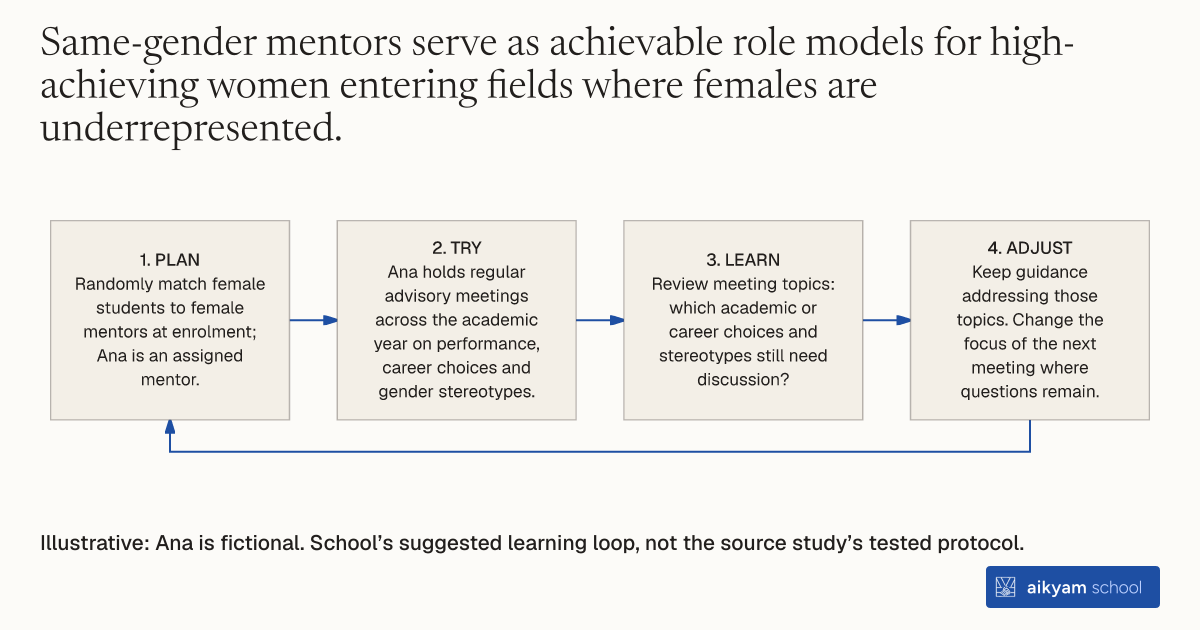
Try, learn and adjust
Check mentoring covers academic and career choices
- Plan: Randomly match female students to female mentors at enrolment; Ana is an assigned mentor.
- Try: Ana holds regular advisory meetings across the academic year on performance, career choices and gender stereotypes.
- Learn: Review meeting topics: which academic or career choices and stereotypes still need discussion?
- Adjust: Keep guidance addressing those topics. Change the focus of the next meeting where questions remain.
Illustrative: Ana is fictional. School’s suggested learning loop, not the source study’s tested protocol.
See source →School’s suggested, untested loop. Observe advisory meetings and topics discussed; do not infer changes in occupational choice.
How
When to use
Women remain underrepresented in technical fields and male-dominated occupations due to a lack of same-gender mentors. Assigning female mentors to high-performing female students challenges career stereotypes and encourages nontraditional career paths. This method supports female students enrolled in academic and professional service institutions.
Assign female mentors to advise high-performing female students during academic programs at military institutions.
- Match female students randomly to female mentors upon enrollment.
- Schedule regular advisory meetings between assigned female mentors and female students across the academic year.
- Discuss occupational choices, career specializations, and academic performance during mentoring sessions.
- Provide career guidance to address gender stereotypes in male-dominated professional fields.
Why it works
Mentoring interactions encourage talented women to overcome social stereotypes and pursue male-dominated occupational tracks.
Example
At a military academy in the United States, researchers evaluated the impact of mentor gender on occupational choice. Assigning female mentors to high-performing women students increased their likelihood of choosing programs with female underrepresentation by 8 percentage points.
About the study
Participants
Female students at a military academy in the United States.
Study Design
Randomized controlled trial evaluating the impact of mentor gender on student occupational choice.
Results
Exposure to female mentors increased the likelihood of high-performing female students choosing male-dominated occupational programs by 8 percentage points.