Research sampling
Sample households from borrower lists
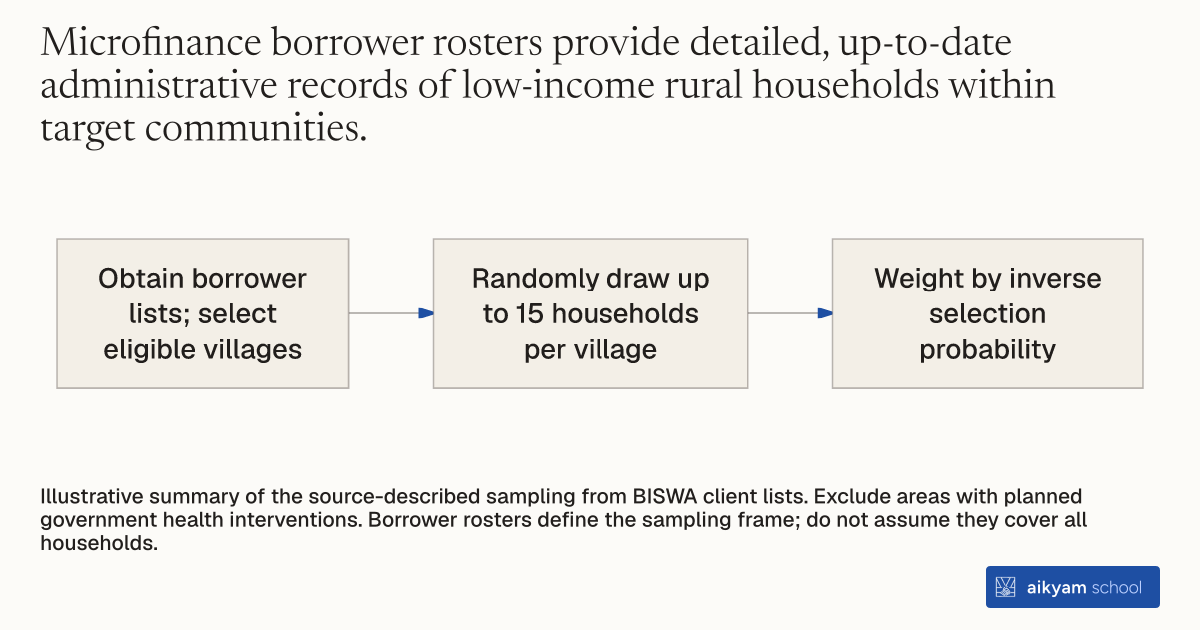
- Obtain borrower lists; select eligible villages
- Randomly draw up to 15 households per village
- Weight by inverse selection probability
Illustrative summary of the source-described sampling from BISWA client lists. Exclude areas with planned government health interventions. Borrower rosters define the sampling frame; do not assume they cover all households.
See source →How
When to use
Field researchers need to sample low-income rural households in areas without updated municipal registries. Random household sampling from general populations can be logistically prohibitive or lack reliable administrative sampling frames. Partnering with a local microfinance institution allows researchers to construct a clear sampling frame using verified borrower client rosters.
Sample target households in rural communities by utilizing administrative client rosters provided by a local microfinance partner.
- Identify a local microfinance organization with an established operational presence across target rural study districts.
- Obtain administrative lists of all active microfinance borrower clients across eligible partner villages.
- Select sample villages across geographic strata where local government health agencies do not plan confounding interventions.
- Draw a random sample of up to 15 borrower households per selected village directly from the microfinance client roster.
- Compute household sampling weights as the inverse probability of selection to construct representative population estimators.
Why it works
Leveraging partner client lists creates a reliable sampling frame and establishes community access without constructing costly censuses.
Example
Researchers sampled 1,947 households containing 10,641 total members across 150 rural villages in five districts of Orissa, India, in May–June 2007. Survey teams selected up to 15 households per village from borrower lists provided by the local micro-lender BISWA.
About the study
Participants
1,947 households with 10,641 members in 150 villages across 5 districts (Balangir, Bargarh, Kandhamal, Keonjhar, Sambalpur) in Orissa, India, where 93 percent of households belong to Scheduled Castes, Scheduled Tribes, or Other Backward Castes.
Study Design
Stratified cluster sampling selected 150 villages from 878 villages with an established BISWA microfinance presence, sampling up to 15 borrower households per village from administrative client lists.
Results
The sampling frame successfully yielded 1,947 surveyed households across 150 villages, with an average household size of 5.46 members and mean monthly per capita expenditure of 655 Rupees.