Research procedure
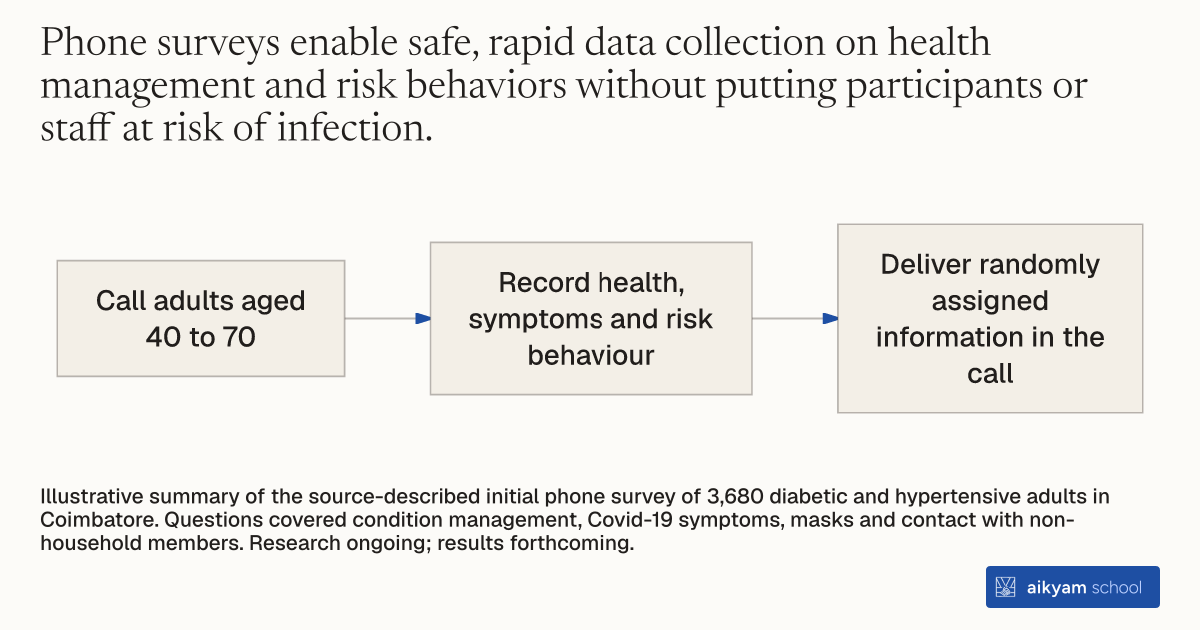
Collect baseline health and behaviour data
- Call adults aged 40 to 70
- Record health, symptoms and risk behaviour
- Deliver randomly assigned information in the call
Illustrative summary of the source-described initial phone survey of 3,680 diabetic and hypertensive adults in Coimbatore. Questions covered condition management, Covid-19 symptoms, masks and contact with non-household members. Research ongoing; results forthcoming.
See source →How
When to use
In a public health crisis, evaluators need data on disease symptoms, self-care practices, and risk-taking behaviors among vulnerable groups. Remote data collection is required when in-person contact poses infection risks. Conduct a phone-based initial survey to measure health status and preventive behaviors for high-risk adults.
Gather baseline health and behavioral data from vulnerable participants during an initial phone call.
- Contact diabetic and hypertensive participants aged 40 to 70 years old by phone.
- Ask questions about overall health status and pre-existing condition management, such as diabetes symptoms.
- Record whether participants currently experience Covid-19 symptoms.
- Measure Covid-19 risk behaviors, including mask wearing frequency and interaction frequency with non-household members.
- Deliver randomized health risk information interventions during the same call as described in the study protocol.
Example
In Coimbatore, Tamil Nadu, India, researchers conducted initial phone surveys with 3,680 diabetic and hypertensive adults aged 40 to 70 years old to measure health status, symptoms, and mask wearing habits.
About the study
Participants
3,680 diabetic and hypertensive individuals aged 40 to 70 years old in Coimbatore, Tamil Nadu, India.
Study Design
Initial phone survey administered during a randomized controlled trial.
Results
Research ongoing; results forthcoming.