Research sampling
Select villages within district strata
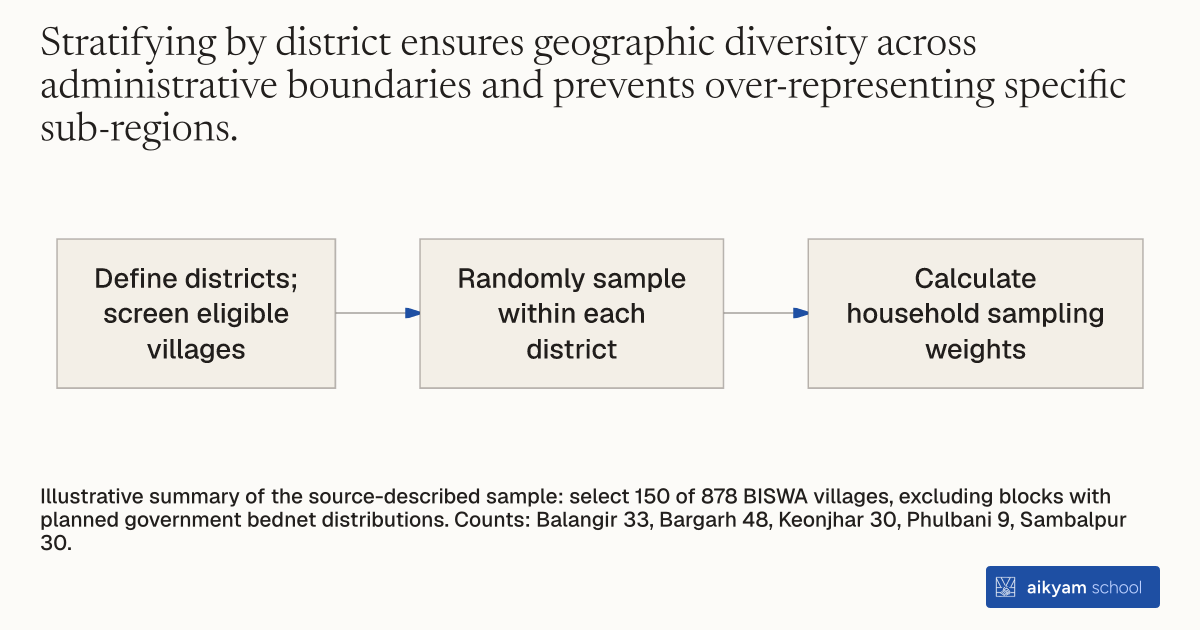
- Define districts; screen eligible villages
- Randomly sample within each district
- Calculate household sampling weights
Illustrative summary of the source-described sample: select 150 of 878 BISWA villages, excluding blocks with planned government bednet distributions. Counts: Balangir 33, Bargarh 48, Keonjhar 30, Phulbani 9, Sambalpur 30.
See source →How
When to use
Researchers need to select study communities across diverse administrative regions while accounting for local organizational networks. Selecting communities without stratification can oversample specific geographic areas or overlap with government health campaigns. Stratifying clusters across district boundaries ensures balanced geographic representation and prevents interference from external public health programs.
Select study villages across multiple administrative districts using stratified cluster sampling based on local institutional partner footprints.
- Define geographic strata corresponding to administrative districts in the target region.
- Exclude study blocks where local government health agencies plan confounding bednet distributions.
- Identify eligible candidate villages where a local partner organization maintains an operational presence.
- Draw a random sample of villages within each district stratum based on regional sampling targets.
- Calculate household sampling weights as the inverse probability of selection to construct representative population estimators.
Why it works
Screening out study blocks with scheduled government health programs avoids confounding treatment effects.
Example
Researchers sampled 150 villages from 878 candidate villages covered by the BISWA microfinance network across five district strata in Orissa, India, in May–June 2007. The process selected 33 villages in Balangir, 48 in Bargarh, 30 in Keonjhar, 9 in Phulbani, and 30 in Sambalpur.
About the study
Participants
150 villages sampled from 878 candidate villages across 5 districts (Balangir, Bargarh, Kandhamal, Keonjhar, Sambalpur) in Orissa, India, covering 1,947 households with 10,641 total members.
Study Design
Stratified cluster sampling treating each district as a separate stratum, randomly selecting villages from a partner microfinance network roster while excluding blocks with planned government bednet distributions.
Results
The sampling framework successfully selected 150 villages across 5 district strata (33 Balangir, 48 Bargarh, 30 Keonjhar, 9 Phulbani, 30 Sambalpur) to establish a representative rural study sample.