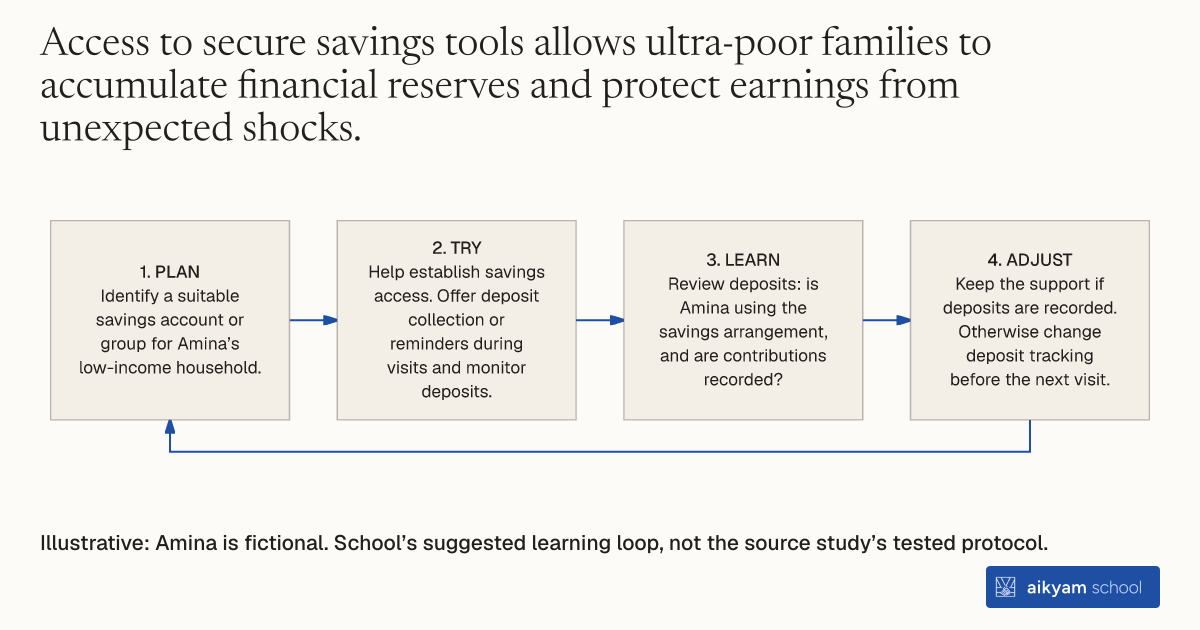
Try, learn and adjust
Check savings access and deposit support
- Plan: Identify a suitable savings account or group for Amina’s low-income household.
- Try: Help establish savings access. Offer deposit collection or reminders during visits and monitor deposits.
- Learn: Review deposits: is Amina using the savings arrangement, and are contributions recorded?
- Adjust: Keep the support if deposits are recorded. Otherwise change deposit tracking before the next visit.
Illustrative: Amina is fictional. School’s suggested learning loop, not the source study’s tested protocol.
See source →School’s suggested learning loop: observe account access and deposits; this check does not establish long-term financial resilience.
How
When to use
Low-income households in extreme poverty face frequent income shocks and lack secure mechanisms to accumulate financial reserves. Without access to formal financial services or structured encouragement, families struggle to build capital for business investments or emergency buffers. Provide access to savings accounts or active encouragement to foster financial resilience among ultra-poor families.
Provide low-income households with access to savings accounts or structured encouragement to build financial reserves.
- Field staff identify local financial institutions or savings mechanisms suitable for ultra-poor participants.
- Program officers assist beneficiaries in opening formal savings accounts or establishing savings groups.
- Field staff offer deposit collection services or regular reminders during visits to promote continuous contributions.
- Implementing teams monitor beneficiary savings deposits to help build emergency buffers and enterprise capital.
Why it works
Building savings creates a financial cushion that supports long-term asset accumulation and self-employment stability.
Example
In Ghana, an evaluation tested providing ultra-poor households with access to savings accounts accompanied by deposit collection services as a standalone intervention.