Research allocation
Reveal household assignments
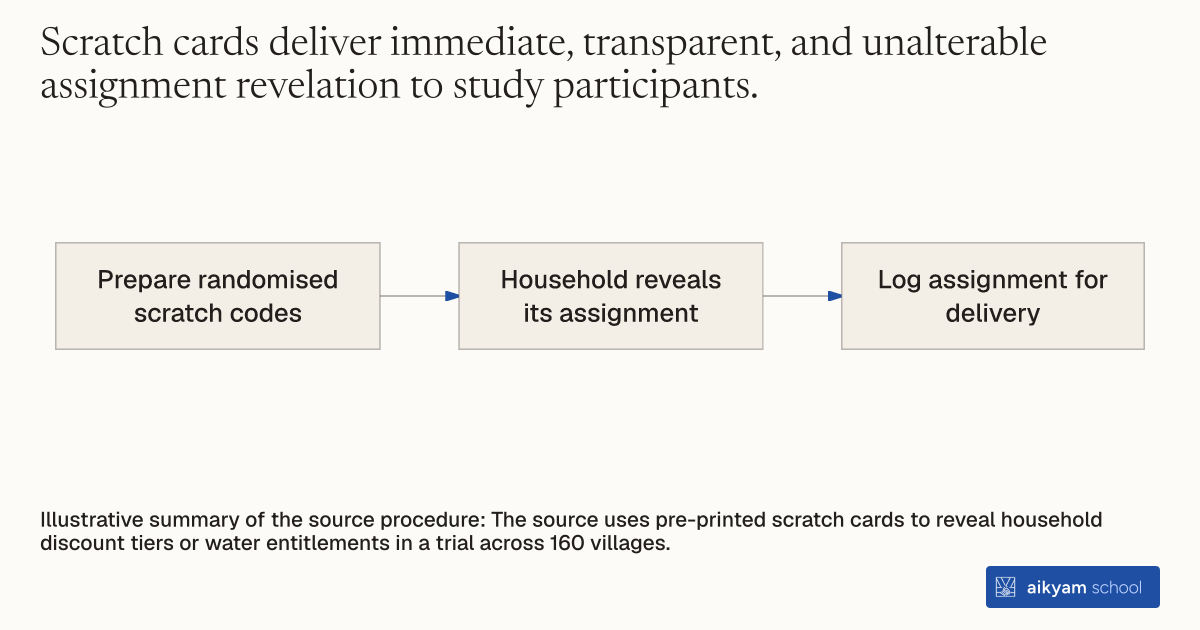
- Prepare randomised scratch codes
- Household reveals its assignment
- Log assignment for delivery
Illustrative summary of the source procedure: The source uses pre-printed scratch cards to reveal household discount tiers or water entitlements in a trial across 160 villages.
See source →How
When to use
Field trials and community program rollouts require transparent, tamper-proof randomization to assign households to treatment conditions. Assigning intervention levels via administrative lists or verbal instructions can create suspicion or enumerator bias. Scratch-card randomization enables field teams to reveal program assignments directly to families in a verified manner.
Assign households to distinct program treatment arms using pre-printed scratch cards distributed during field visits.
- Field teams prepare scratch cards pre-loaded with randomized program assignment codes across trial tiers.
- Enumerators visit selected households across target villages during study enrolment.
- Field staff present a sealed scratch card directly to each household head or representative.
- Household members scratch off the card covering to reveal their assigned discount tier or entitlement allowance.
- Enumerators log the revealed assignment into study tracking databases for program implementation.
Why it works
The visible scratch-off mechanism prevents selection bias and eliminates enumerator tampering during household enrolment.
Example
Researchers used scratch cards to randomize program offers across 60,000 households in 160 villages in rural Odisha, India, revealing specific discount tiers or free water entitlements to each participant.
About the study
Participants
60,000 households across 160 villages in rural Odisha, India, where 26 percent of households lacked clean drinking water.
Study Design
Randomized controlled trial dividing 160 villages into four study groups, utilizing household-level scratch cards to randomly assign families to specific pricing, discount, and water entitlement arms.
Results
Successfully executed individual household-level randomization across 60,000 families, enabling precise evaluation of household clean water demand and health outcomes.