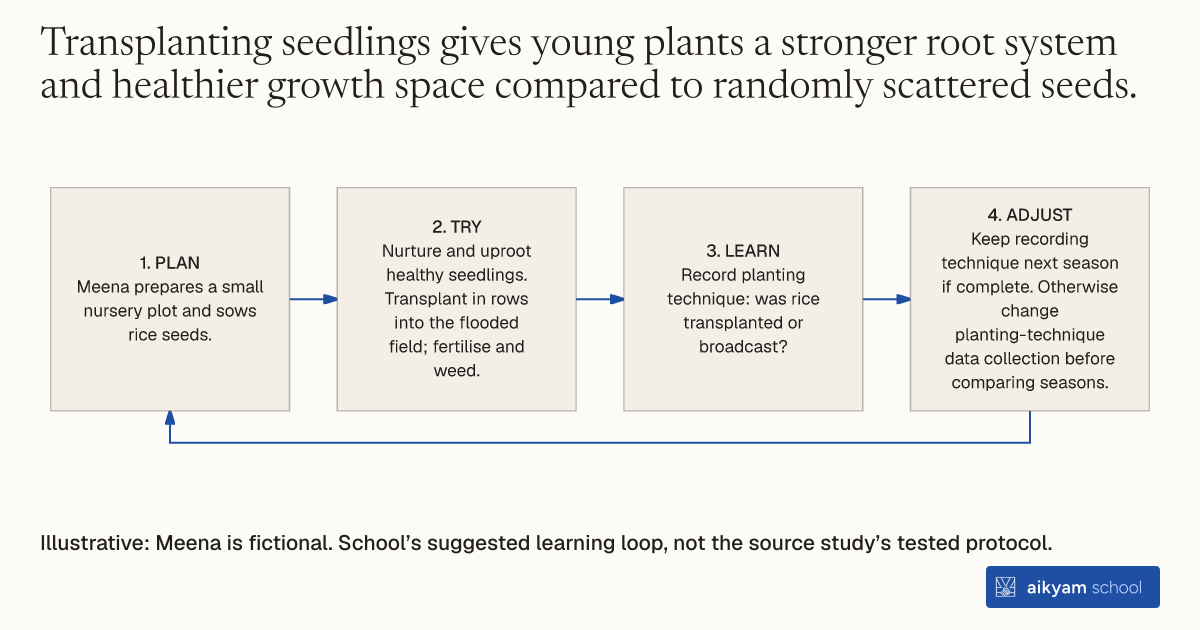
Try, learn and adjust
Check the switch to seedling transplanting
- Plan: Meena prepares a small nursery plot and sows rice seeds.
- Try: Nurture and uproot healthy seedlings. Transplant in rows into the flooded field; fertilise and weed.
- Learn: Record planting technique: was rice transplanted or broadcast?
- Adjust: Keep recording technique next season if complete. Otherwise change planting-technique data collection before comparing seasons.
Illustrative: Meena is fictional. School’s suggested learning loop, not the source study’s tested protocol.
See source →School’s suggested learning loop: observe planting technique and field maintenance. School’s loop is not a tested cultivation protocol or proof of higher yields.
How
When to use
Smallholder rice farmers in flood-prone regions often broadcast seeds directly into fields to save labor costs. Broadcasting seeds requires low effort but yields significantly fewer crops. Transitioning farmers to transplanting seedlings increases agricultural output when risk-reducing seeds protect the crop investment.
Shift smallholder rice planting from direct seed broadcasting to seedling nursery cultivation and transplanting.
- Farmers prepare a small dedicated nursery plot to sow rice seeds.
- Farmers nurture seeds in the nursery until young seedlings emerge.
- Farmers manually uproot healthy seedlings from the nursery plot.
- Farmers transplant seedlings in organized rows into the flooded main field.
- Farmers maintain transplanted fields with adequate fertilizer and weeding.
Why it works
Protecting crops from flood risk encourages farmers to dedicate the extra labor required for seedling transplanting.
Example
Researchers introduced flood-tolerant Swarna-Sub1 seeds to smallholders in Bhadrak and Balasore districts, Odisha, India. Access to flood protection reduced fear of crop loss, prompting farmers to decrease low-yield seed broadcasting by 6.3 percentage points in favor of transplanting seedlings.
About the study
Participants
128 villages in Bhadrak and Balasore districts, Odisha, India; 1,280 smallholder farmers; 56 percent lived below the poverty line and owned 0.84 hectares of land on average.
Study Design
Two-year randomized controlled trial measuring planting technique choices (broadcasting versus seedling transplanting) across treatment mini-kit recipients, comparison non-recipients, and control villages over the 2011–2012 flood season and 2012–2013 non-flood season.
Results
Farmers receiving Swarna-Sub1 seeds were 6.3 percentage points less likely to plant seeds by broadcasting into fields, switching instead to the more labor-intensive and productive seedling transplanting technique.