Try, learn and adjust
Check responses to solar savings messages
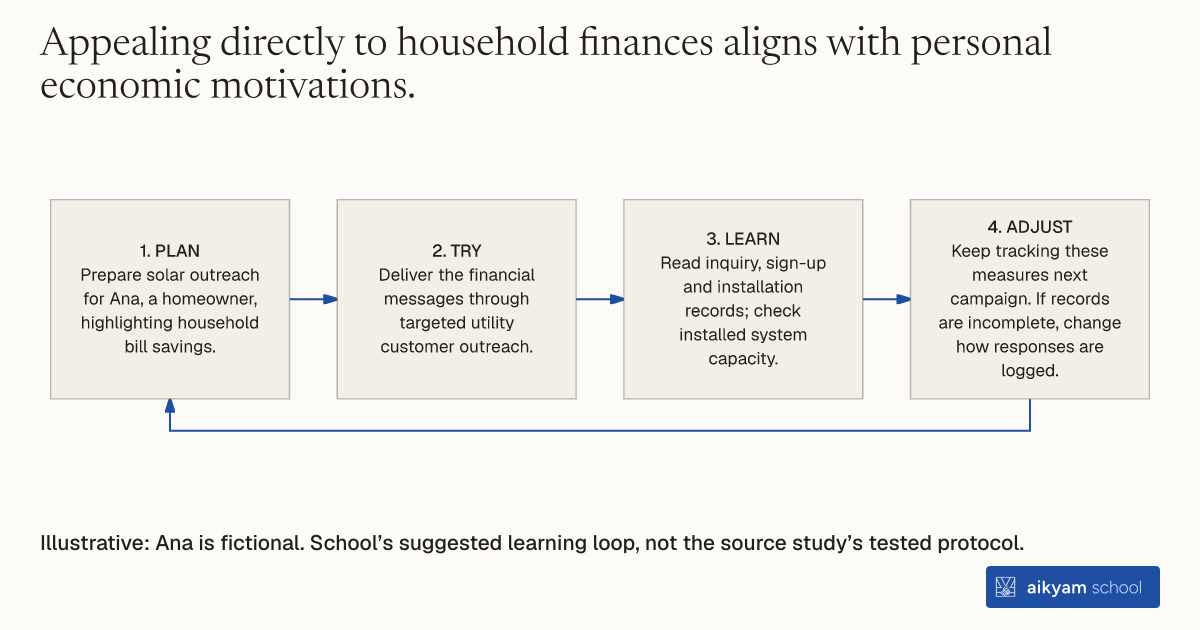
- Plan: Prepare solar outreach for Ana, a homeowner, highlighting household bill savings.
- Try: Deliver the financial messages through targeted utility customer outreach.
- Learn: Read inquiry, sign-up and installation records; check installed system capacity.
- Adjust: Keep tracking these measures next campaign. If records are incomplete, change how responses are logged.
Illustrative: Ana is fictional. School’s suggested learning loop, not the source study’s tested protocol.
See source →School’s suggested, untested learning loop. Observe inquiries, enrolment, installation requests and generation capacity; this loop does not establish message effects.
How
When to use
Municipalities face low residential rooftop solar adoption when relying on standard public outreach. Informational campaigns frequently use broad environmental appeals that fail to move households to action. Self-interest message framing targets residential property owners by emphasizing personal financial gain instead of abstract community goodwill.
Frame residential rooftop solar marketing campaigns around personal financial savings rather than environmental altruism.
- Draft outreach materials and communication copy for residential solar recruitment drives.
- Emphasize household utility bill reductions, financial returns, and direct cost savings in marketing copy.
- Deliver self-interest messages across residential utility customer lists through targeted outreach channels.
- Track inquiry volumes, program sign-up rates, and solar panel installation requests.
- Measure total generation capacity and system productivity of installed rooftop equipment across participating households.
Why it works
Direct financial messaging encourages property owners to install larger, higher-capacity solar systems to maximize ongoing utility bill savings.
Example
A natural field experiment in Connecticut evaluated community solar campaigns comparing self-interest messaging against pro-social appeals. Households receiving self-interest messages enrolled in solar programs at higher rates and installed higher-capacity solar systems.
About the study
Participants
Residential property owners and utility customers across target communities in Connecticut, United States.
Study Design
Natural field experiment comparing self-interest marketing copy against pro-social messaging strategies in residential solar outreach campaigns.
Results
Self-interest messaging proved significantly more effective at increasing residential rooftop solar adoption than pro-social appeals. Additionally, households exposed to self-interest messaging installed higher-capacity, more productive solar systems.