Research procedure
Separate baseline and delivery teams
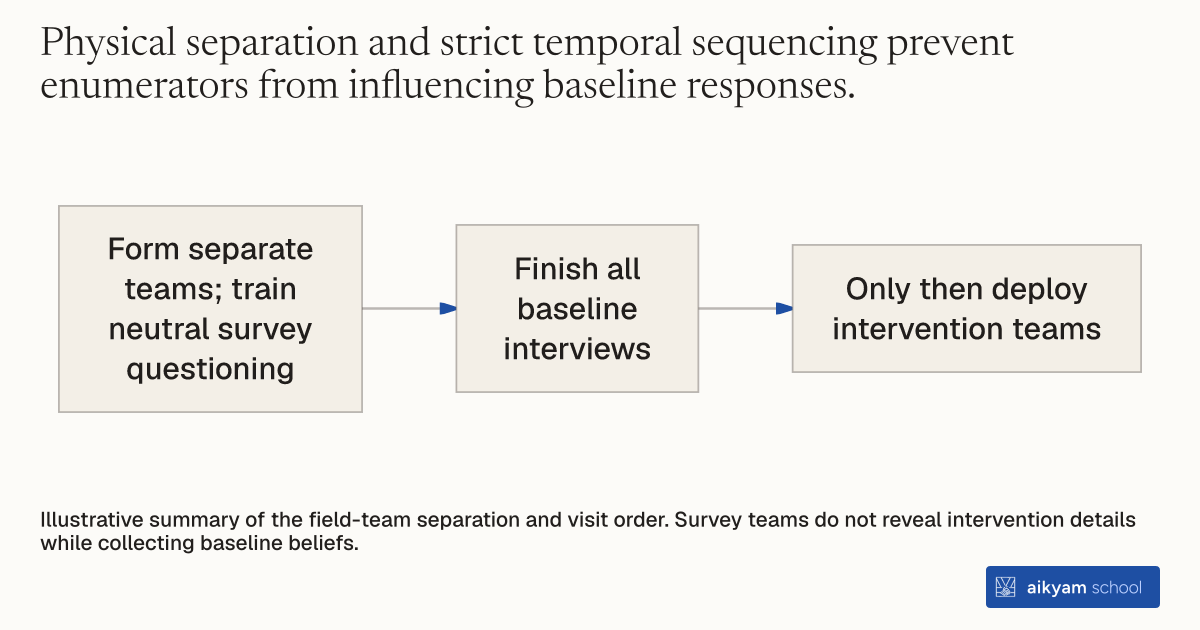
- Form separate teams; train neutral survey questioning
- Finish all baseline interviews
- Only then deploy intervention teams
Illustrative summary of the field-team separation and visit order. Survey teams do not reveal intervention details while collecting baseline beliefs.
See source →How
When to use
Field evaluation teams risk introducing surveyor bias or spillover contamination when respondents associate baseline data collection with an upcoming information intervention. Program directors use this method to separate data collectors from program implementers so baseline measurements capture unbiased beliefs.
Separate field enumerator teams from intervention teams and sequence survey visits to finish completely before program delivery begins.
- Form two distinct field teams: an independent survey evaluation team and a dedicated intervention team.
- Train survey enumerators to maintain a neutral tone and ask baseline questions without revealing intervention details.
- Deploy the survey evaluation team to complete all baseline interviews across sample clusters.
- Verify that baseline interviews finish entirely before sending intervention teams into the field.
- Deploy the intervention team to deliver program activities only after all baseline data collection ends.
Why it works
This ensures that baseline data reflects true pre-intervention beliefs and eliminates surveyor-driven information spillovers.
Example
Researchers in Morogoro Region, Tanzania split field operations into two distinct teams, deploying 17 enumerators and 4 supervisors. The survey team completed all baseline interviews among 1,479 farmers and 232 agro-dealers before the intervention team arrived to deliver posters, pamphlets, and village meetings.
About the study
Participants
17 enumerators and 4 supervisors surveying 1,479 farmers and 232 agro-dealers across 148 villages and 89 markets in Morogoro Region, Tanzania.
Study Design
Randomized controlled trial with strict operational separation between evaluation enumerators and intervention delivery teams.
Results
Baseline survey teams successfully captured pre-treatment beliefs where 77% of farmers expressed quality concerns (expecting 2 out of 10 bags to be bad) without inducing surveyor information spillovers.