Try, learn and adjust
Check seeds and advice are delivered together
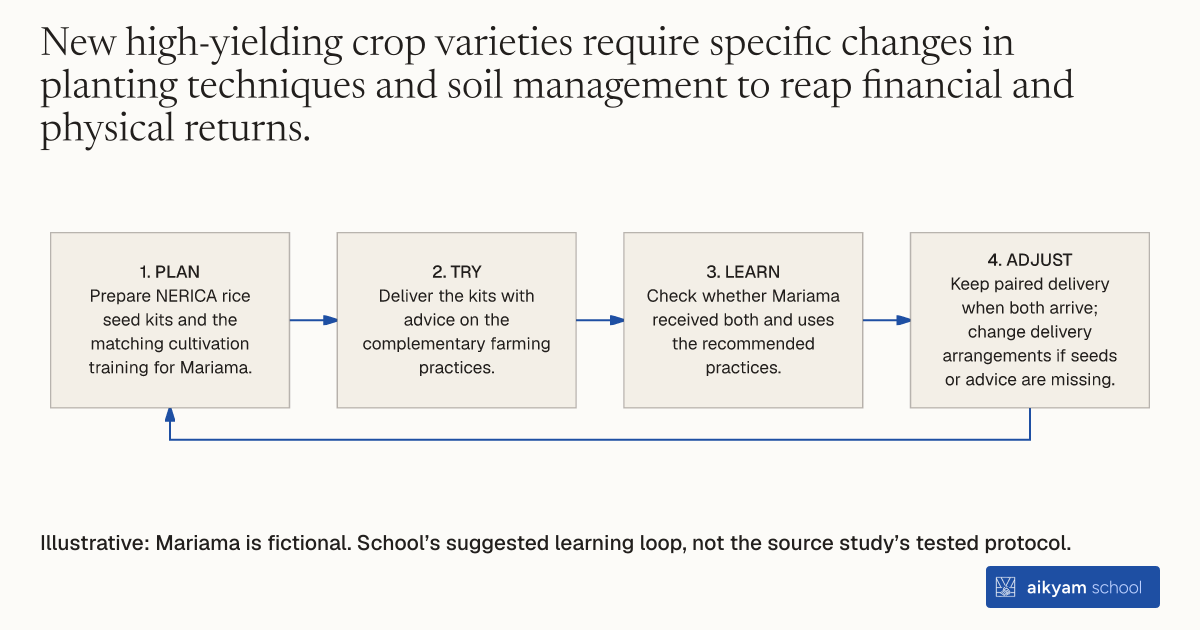
- Plan: Prepare NERICA rice seed kits and the matching cultivation training for Mariama.
- Try: Deliver the kits with advice on the complementary farming practices.
- Learn: Check whether Mariama received both and uses the recommended practices.
- Adjust: Keep paired delivery when both arrive; change delivery arrangements if seeds or advice are missing.
Illustrative: Mariama is fictional. School’s suggested learning loop, not the source study’s tested protocol.
See source →Observe seed receipt, advisory delivery and use of complementary practices; seeds alone did not raise yields in the example. School suggests this learning loop; it was not tested by the source.
How
When to use
Distributing advanced physical inputs without accompanying advisory services frequently fails to generate crop yield improvements. New agricultural technologies often require specific altered production practices to realize potential returns. This method helps agricultural development programs package new seed varieties together with technical advisory services to ensure yield gains for smallholder farmers.
Bundle distributions of new physical inputs together with mandatory advisory extension services on required production practices.
- Extension managers select a new high-yielding seed variety requiring specific cultivation methods.
- Program coordinators package the seed kits together with structured technical extension training modules.
- Agricultural extension agents deliver the physical seed kits directly to target smallholder farmers.
- Extension officers conduct paired advisory sessions teaching recommended production practices for the seed variety.
- Smallholder farmers adopt the complementary agronomic practices alongside the new seeds on their fields.
Why it works
Combining inputs with technical information ensures farmers adopt complementary practices rather than using new technologies in isolation.
Example
In Sierra Leone, a randomized evaluation tested the rollout of a new improved rice seed variety, NERICA. Farmers who received extension services alongside free seed kits experienced crop yield increases, whereas farmers who received seeds alone experienced zero gains in yields.
About the study
Participants
Smallholder rice farmers in rural communities in Sierra Leone.
Study Design
Randomized controlled trial comparing crop yield outcomes for smallholder farmers receiving improved NERICA rice seed kits bundled with extension services against those receiving seed kits alone.
Results
Crop yields only increased for farmers who received extension services alongside free NERICA seed kits, while farmers receiving seeds alone did not experience gains in yields.