Try, learn and adjust
Check disposable bag charges and choices
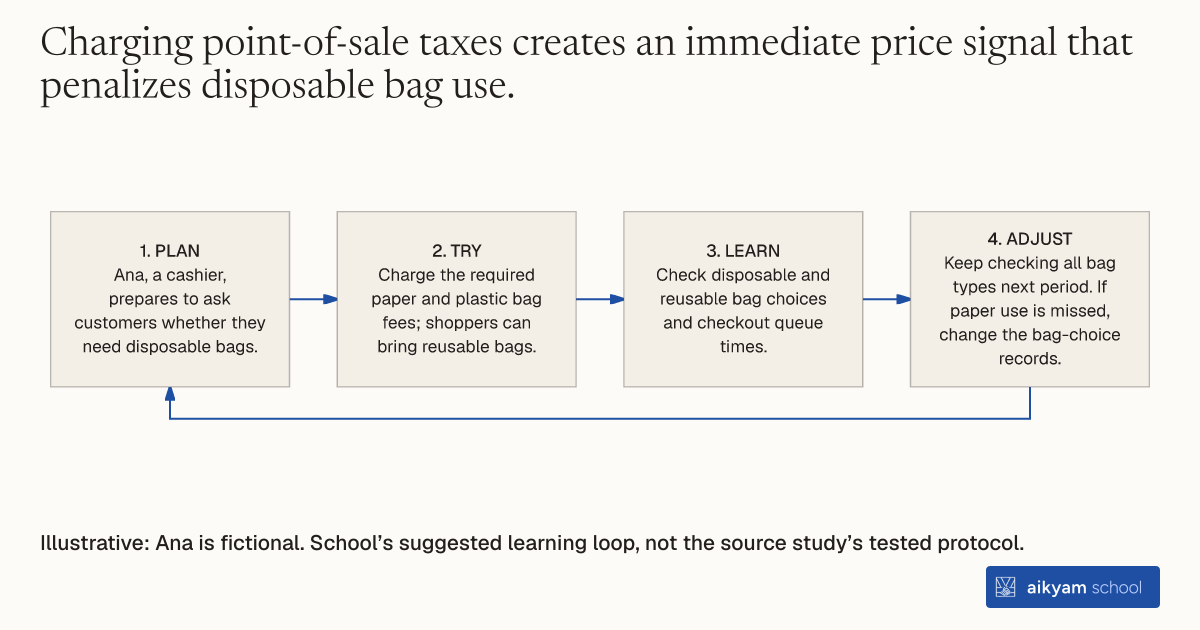
- Plan: Ana, a cashier, prepares to ask customers whether they need disposable bags.
- Try: Charge the required paper and plastic bag fees; shoppers can bring reusable bags.
- Learn: Check disposable and reusable bag choices and checkout queue times.
- Adjust: Keep checking all bag types next period. If paper use is missed, change the bag-choice records.
Illustrative: Ana is fictional. School’s suggested learning loop, not the source study’s tested protocol.
See source →School’s suggested, untested learning loop. Observe bag choices and queue times; plastic bag bans without paper fees can shift demand to paper.
How
When to use
Municipalities face excessive single-use plastic bag consumption that contributes to plastic pollution and solid waste volume. Consumers default to using disposable shopping bags provided at retail checkout points. Levying taxes or fees on single-use plastic bags penalizes disposable bag use and encourages reusable alternatives.
Impose financial taxes or fees on single-use plastic bags at retail checkout registers to reduce disposable bag waste.
- Enact local legislation requiring retail stores and supermarkets to charge a tax or fee on disposable plastic bags.
- Direct grocery retailers to collect taxes on disposable paper and plastic bags at point-of-sale checkout counters.
- Require retail clerks to ask customers if they need disposable bags before charging the required fee.
- Allow shoppers to bring reusable plastic or cloth bags to bypass disposable bag charges completely.
- Pair single-use plastic bag bans with mandatory paper bag fees to prevent shoppers from shifting exclusively to paper bags.
Why it works
The financial charge prompts shoppers to bring reusable bags to avoid incremental checkout expenses.
Example
Municipal grocery programs across Washington, D.C., Chicago, California, and Uruguay implemented taxes and fees on disposable plastic bags. Program evaluations showed that taxes significantly decreased disposable plastic bag usage while increasing the adoption of reusable shopping bags.
About the study
Participants
Grocery store shoppers and supermarket customers across Washington, D.C., Chicago, California, and Uruguay across five evaluations.
Study Design
Quasi-experiments, field experiments, and difference-in-differences measuring checkout bag choices, queue times, and reusable bag adoption rates.
Results
Taxes on single-use plastic bags significantly reduced disposable bag use and increased reusable bag consumption. Unintended consequences included increased checkout queue times and shifts toward paper bags when plastic bag bans lacked paper bag fees.