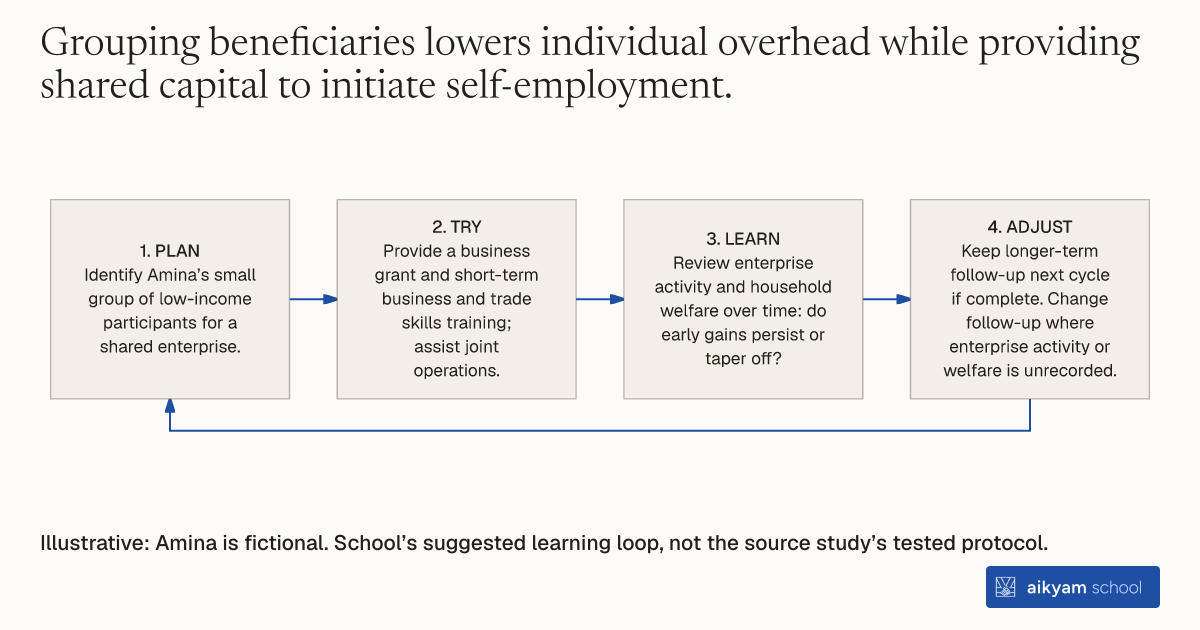
Try, learn and adjust
Check shared enterprise support and longer-term activity
- Plan: Identify Amina’s small group of low-income participants for a shared enterprise.
- Try: Provide a business grant and short-term business and trade skills training; assist joint operations.
- Learn: Review enterprise activity and household welfare over time: do early gains persist or taper off?
- Adjust: Keep longer-term follow-up next cycle if complete. Change follow-up where enterprise activity or welfare is unrecorded.
Illustrative: Amina is fictional. School’s suggested learning loop, not the source study’s tested protocol.
See source →School’s suggested, untested loop. Observe enterprise activity and economic welfare over time; do not assume early gains last.
How
When to use
Low-income households facing poverty often lack capital and technical skills needed to launch small businesses. Individual asset transfers can be costly to scale across communities. Provide group microenterprise grants paired with training to help small teams establish shared businesses.
Deliver microenterprise funding and short-term training to small groups of low-income beneficiaries to launch shared business activities.
- Implementation teams identify small groups of low-income participants.
- Program managers distribute business development grants or funding to each group.
- Technical trainers deliver short-term business and trade skills instruction.
- Field staff assist group members as they jointly manage enterprise operations.
Why it works
However, collective business models often deliver initial short-term gains that taper off over longer horizons.
Example
In Uganda, microenterprises run jointly by three households observed gains in key economic welfare indicators, increased entrepreneurial activity, and a reduction in poverty.