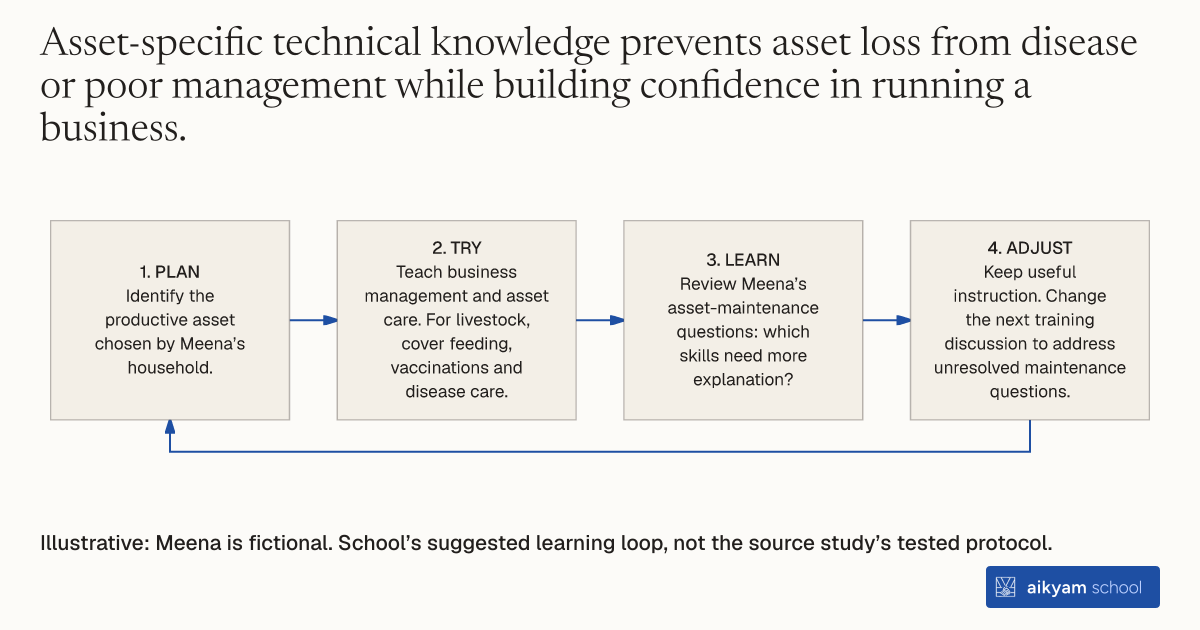
Try, learn and adjust
Use asset-maintenance needs to guide training
- Plan: Identify the productive asset chosen by Meena’s household.
- Try: Teach business management and asset care. For livestock, cover feeding, vaccinations and disease care.
- Learn: Review Meena’s asset-maintenance questions: which skills need more explanation?
- Adjust: Keep useful instruction. Change the next training discussion to address unresolved maintenance questions.
Illustrative: Meena is fictional. School’s suggested learning loop, not the source study’s tested protocol.
See source →School’s suggested, untested loop. Observe asset-care knowledge and maintenance needs; programme results do not isolate training effects.
How
When to use
Extremely poor individuals often lack the skills needed to run a business or manage assets effectively. Without technical training, transferred assets like livestock risk high mortality or low productivity. Program managers deliver asset-specific technical skills training to help ultra-poor participants succeed in their chosen enterprises.
Train ultra-poor participants in business management and asset-specific skills to ensure effective asset maintenance.
- Identify the specific productive asset selected by each participating household.
- Provide direct training on general business operations and financial management.
- Teach households who chose livestock how to rear their animals properly.
- Instruct livestock owners on administering necessary vaccinations and feed routines.
- Train participants on diagnosing and treating livestock diseases to prevent asset loss.
Why it works
Proper maintenance ensures that transferred assets generate sustained earnings for the household.
Example
In West Bengal, India, Bandhan delivered technical skills training to 514 ultra-poor households following asset allocation. Participants selecting livestock received specialized instruction on animal rearing, feeding, vaccinations, and disease treatment, enabling initial earnings that supported non-farm business investments.
About the study
Participants
978 ultra-poor households in Murshidabad, West Bengal, India, consuming 40 US dollars per month on average.
Study Design
Randomized controlled trial comparing 514 households receiving the 18-month Graduation package against 464 comparison households over ten years.
Results
Ten years after asset transfer, program participants earned significantly higher income and spent 21 minutes more per day on productive activities compared to 3 hours 45 minutes in the comparison group.