Try, learn and adjust
Check out-group perspectives are included
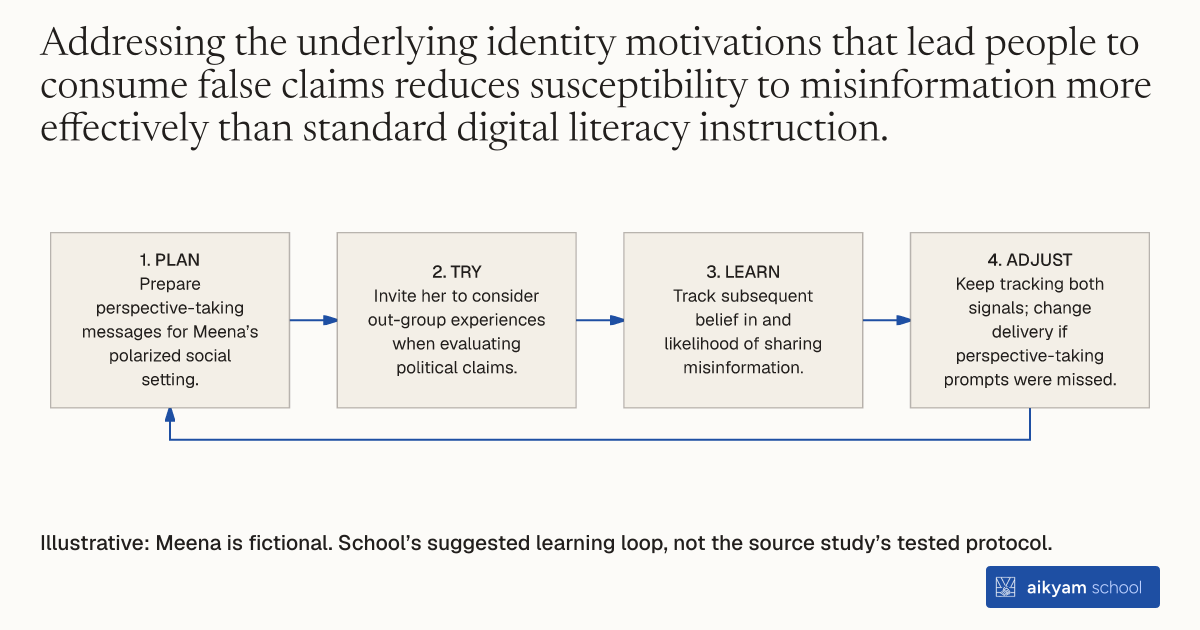
- Plan: Prepare perspective-taking messages for Meena’s polarized social setting.
- Try: Invite her to consider out-group experiences when evaluating political claims.
- Learn: Track subsequent belief in and likelihood of sharing misinformation.
- Adjust: Keep tracking both signals; change delivery if perspective-taking prompts were missed.
Illustrative: Meena is fictional. School’s suggested learning loop, not the source study’s tested protocol.
See source →Belief in and likelihood of sharing misinformation; no assumed improvement. School’s suggested learning loop, not a source-tested cycle.
How
When to use
Citizens consume and spread online misinformation driven by political identity and negative feelings toward opposing groups. Standard digital literacy videos fail to improve news discernment when people are motivated by social identity. This method helps civil society organizations reduce belief in and spread of false claims by encouraging empathy toward out-group members.
Encourage citizens to empathize with members of social out-groups through targeted social identity interventions before evaluating online information.
- Identify target political or social groups experiencing identity-based polarization.
- Develop educational interventions focused on social identity and out-group perspective-taking.
- Present messaging that prompts individuals to consider the perspectives and experiences of out-group members.
- Encourage participants to apply out-group empathy when encountering controversial political claims.
- Track participants' subsequent belief in and likelihood of spreading online misinformation.
Example
In Côte d'Ivoire, researchers evaluated social identity-based interventions encouraging empathy with out-group members, which curbed belief in and likelihood of spreading misinformation, whereas standard video-based digital literacy training had no effect.
About the study
Participants
Citizens and news consumers in Côte d'Ivoire.
Study Design
Field experiment comparing social identity-based interventions against standard video-based digital literacy training and unexposed control groups.
Results
Curbed belief in and likelihood of spreading misinformation, while standard video-based digital literacy training had no effect.