Try, learn and adjust
Check peer advice on commercial crops
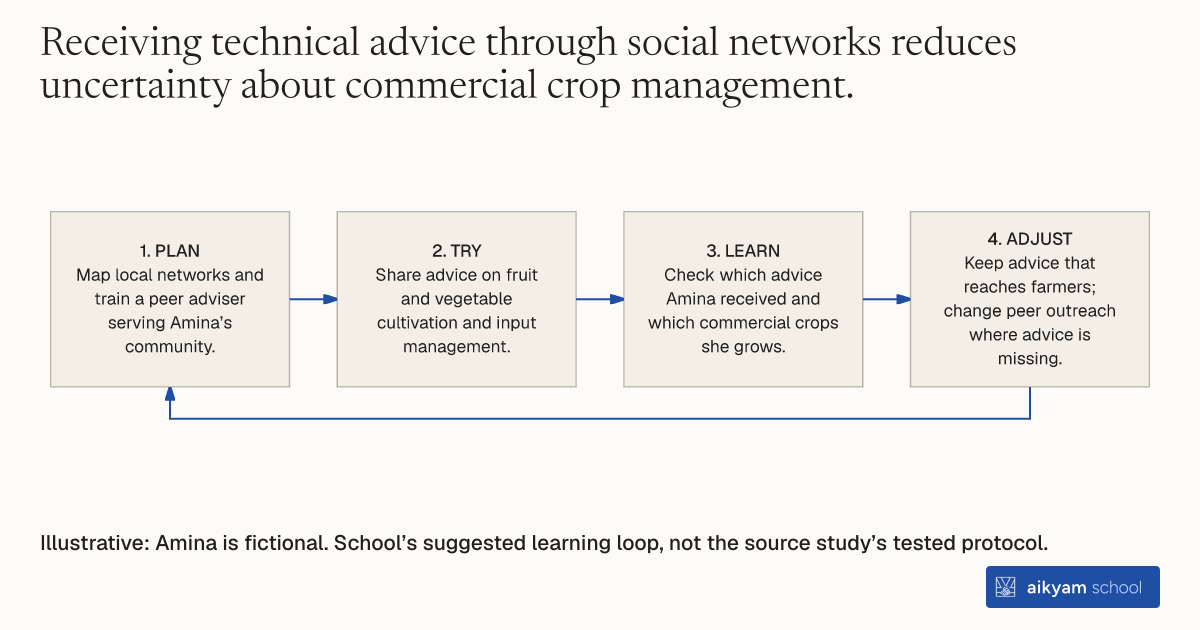
- Plan: Map local networks and train a peer adviser serving Amina’s community.
- Try: Share advice on fruit and vegetable cultivation and input management.
- Learn: Check which advice Amina received and which commercial crops she grows.
- Adjust: Keep advice that reaches farmers; change peer outreach where advice is missing.
Illustrative: Amina is fictional. School’s suggested learning loop, not the source study’s tested protocol.
See source →Observe receipt of advice, crop choices and farm profits without assuming a gain. School suggests this learning loop; it was not tested by the source.
How
When to use
Subsistence smallholders often remain locked in low-margin staple crop production due to technical uncertainty regarding commercial crop management. Without reliable advisory support, farmers hesitate to shift land and labor toward higher-value market crops. This method helps extension programs deliver agricultural advice through local social networks to encourage crop diversification.
Disseminate agricultural advisory services through local social networks to guide smallholder farmers in cultivating high-value commercial crops.
- Extension managers map local social networks within target subsistence farming communities.
- Program coordinators train peer advisors within social networks on commercial crop cultivation techniques.
- Peer advisors share technical advice on growing marketable fruits and vegetables with network members.
- Smallholder farmers receive peer advisory guidance on input management and crop production.
- Smallholders transition portions of their land from subsistence staples to high-value commercial crops.
Why it works
Peer dissemination provides reliable guidance that encourages smallholders to allocate resources toward profitable market crops.
Example
In Uganda, a program leveraged social networks to disseminate agricultural advice to subsistence farmers. This intervention resulted in a 44 percent increase in agricultural profits, driven partly by an increase in farmers growing marketable crops like vegetables and fruit.
About the study
Participants
Subsistence farming households in rural Uganda.
Study Design
Randomized controlled trial evaluating the impact of disseminating agricultural advice through local social networks on crop choice and farm profits.
Results
Disseminating agricultural advice through social networks resulted in a 44 percent increase in agricultural profits among subsistence farmers, driven partly by an increase in farmers growing marketable crops such as vegetables and fruit.