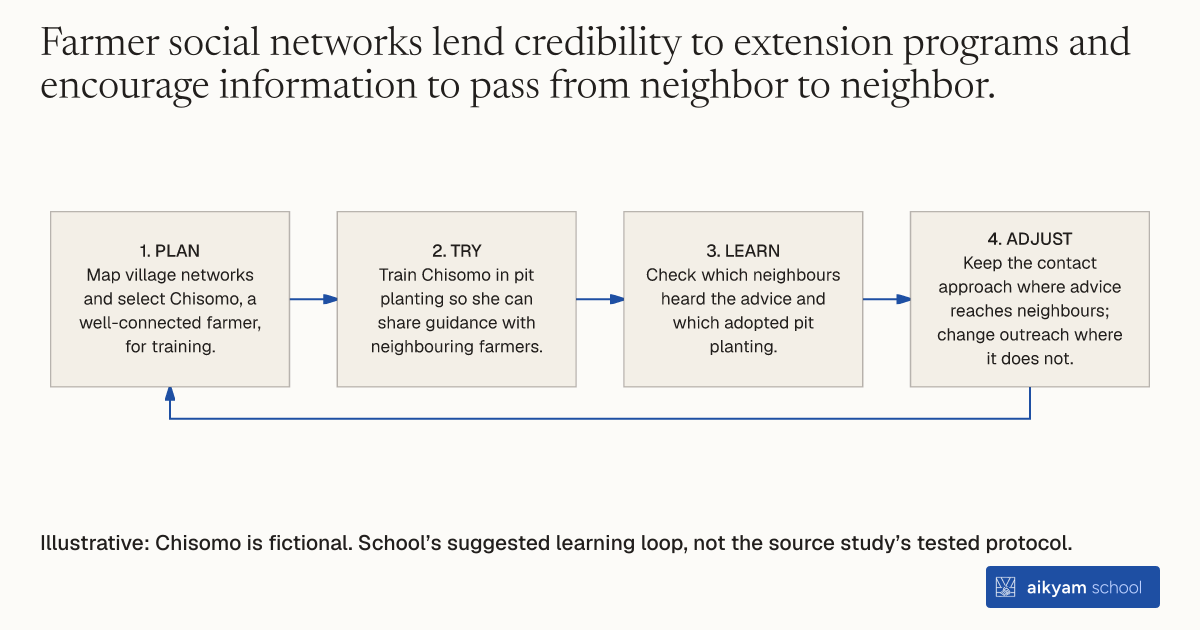
Try, learn and adjust
Check whether contact farmers share pit planting advice
- Plan: Map village networks and select Chisomo, a well-connected farmer, for training.
- Try: Train Chisomo in pit planting so she can share guidance with neighbouring farmers.
- Learn: Check which neighbours heard the advice and which adopted pit planting.
- Adjust: Keep the contact approach where advice reaches neighbours; change outreach where it does not.
Illustrative: Chisomo is fictional. School’s suggested learning loop, not the source study’s tested protocol.
See source →Observe social connections, awareness and adoption; a delivery check does not establish impact. School suggests this learning loop; it was not tested by the source.
How
When to use
Top-down extension services frequently fail to reach remote smallholder farmers directly or lack community trust. Identifying well-connected farmers in local social networks can drive technology diffusion through peer-to-peer communication. This method helps agricultural extension programs identify peer leaders to accelerate the adoption of unfamiliar farming practices.
Identify and train contact farmers situated at key central positions in social networks to demonstrate and share new agricultural practices with peer farmers.
- Extension managers map community social networks before launching extension programs to identify well-connected farmers.
- Program directors select contact farmers positioned at central network nodes across targeted farming villages.
- Agricultural extensionists deliver intensive technical training to selected contact farmers on new practices such as pit planting.
- Contact farmers routinely share practical guidance and discuss pit planting with neighboring farmers in their social network.
- Neighboring farmers with multiple social connections observe these practices and adopt pit planting on their maize fields over two years.
Why it works
Social proximity allows peer leaders to draw on local knowledge to tailor messaging and build trust.
Example
In Malawi, researchers trained contact farmers situated in specific social network positions to promote pit planting among maize farmers. Farmers who had social ties with multiple contact farmers were 33 percent more likely to have heard about pit planting and 90 percent more likely to adopt the technique by the second year relative to unconnected farmers.
About the study
Participants
Small-scale maize farmers in rural communities in Malawi.
Study Design
Randomized controlled trial evaluating how contact farmer placement within village social networks affected peer farmer information diffusion and adoption of pit planting.
Results
Farmers connected to multiple contact farmers were 33 percent more likely to hear about pit planting and 90 percent more likely to adopt the technique by the second year relative to farmers with no social connections.