Research mapping
Map social barriers to seed sharing
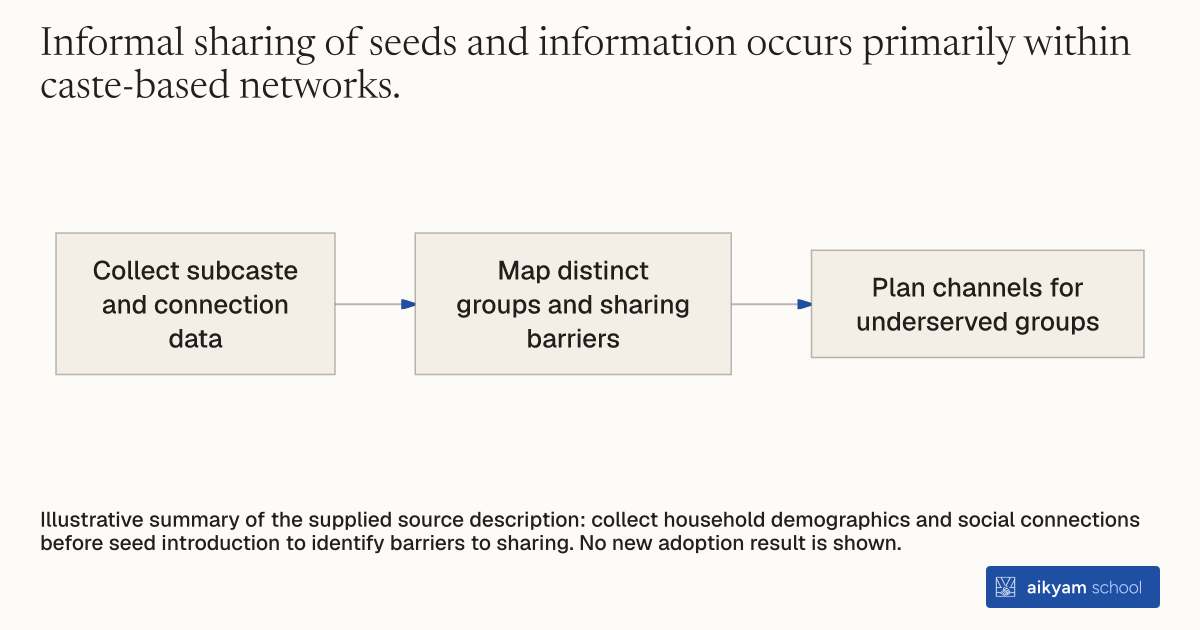
- Collect subcaste and connection data
- Map distinct groups and sharing barriers
- Plan channels for underserved groups
Illustrative summary of the supplied source description: collect household demographics and social connections before seed introduction to identify barriers to sharing. No new adoption result is shown.
See source →How
When to use
Smallholder farmers rely on local social networks to learn about and trade new seed varieties. In divided communities, informal seed sharing stays within social groups and fails to reach other subcastes. Mapping distinct subcaste groups helps agricultural programs design targeted distribution strategies that cross social divides.
Map distinct social and subcaste groups in target communities to ensure technology diffusion reaches all villagers.
- Field researchers visit target agricultural villages prior to introducing new seed varieties.
- Program staff collect demographic details from households, including subcaste identity.
- Analysts measure shared social connections and quantify the number of distinct subcaste groups in each village.
- Field teams identify social divisions that restrict informal peer-to-peer sharing.
- Program managers design targeted distribution channels to reach underserved subcaste groups directly.
Why it works
Identifying underlying social structures allows programs to bypass local sharing barriers and deliver seeds across divided groups.
Example
In 126 villages across Bhadrak and Balasore districts in Odisha, researchers tracked seed adoption across subcaste groups over four years. Farmers in homogeneous villages adopted seeds at rates 8 to 9 percentage points higher than those in socially divided villages.
About the study
Participants
126 villages in Bhadrak and Balasore districts, Odisha, India.
Study Design
Longitudinal randomized evaluation tracking seed usage, production decisions, demographic details including subcaste identity, and distinct subcaste groups per village from 2011 to 2015.
Results
Four years after introduction, seed adoption was 8 to 9 percentage points higher in homogeneous villages relative to 1.7 percent in socially divided villages, representing an increase of over 370 percent.