Research groups
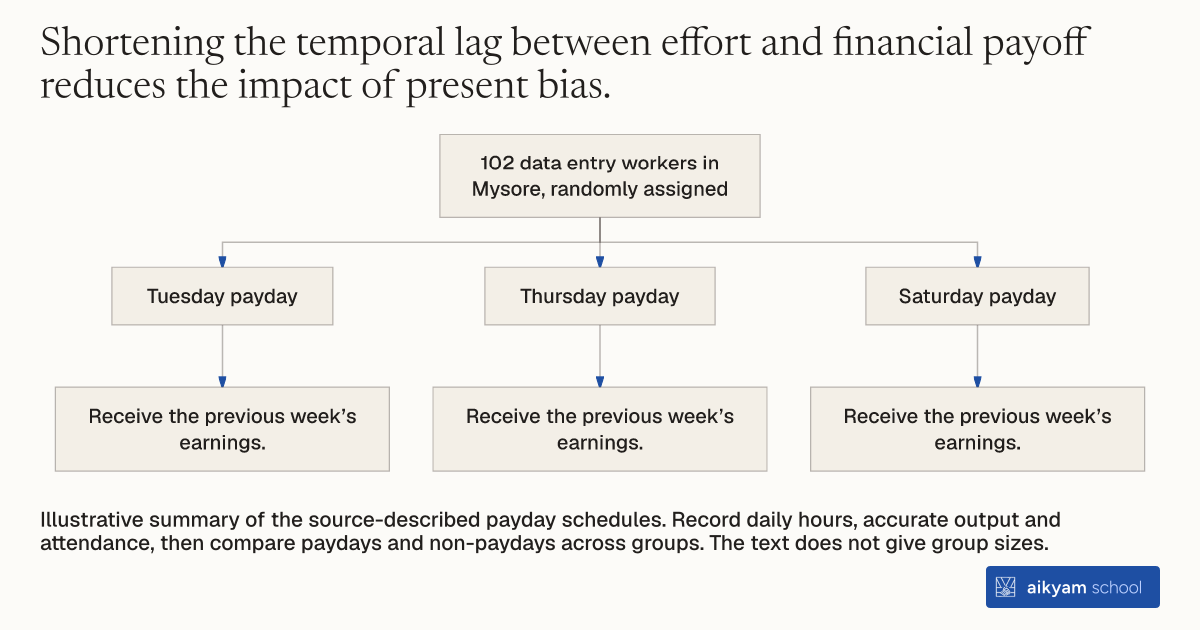
Randomise weekly paydays
102 data entry workers in Mysore, randomly assigned
- Tuesday payday
- Receive the previous week’s earnings.
- Thursday payday
- Receive the previous week’s earnings.
- Saturday payday
- Receive the previous week’s earnings.
Illustrative summary of the source-described payday schedules. Record daily hours, accurate output and attendance, then compare paydays and non-paydays across groups. The text does not give group sizes.
See source →How
When to use
A firm or research team needs to measure how the timing of compensation affects worker effort across a pay cycle. When workers experience present bias, the temporal lag between effort and payout causes procrastination early in the pay cycle. Assigning workers to different paydays allows organizations to measure payday effects and optimize pay schedule frequency.
Randomly assign workers to staggered weekly payment days to evaluate output variations across pay cycles.
- Divide the firm's workforce into distinct experimental groups.
- Randomly assign each group to receive their previous week's earnings on a specific day of the week, such as Tuesday, Thursday, or Saturday.
- Calculate total work hours and accurate output daily for each worker throughout the pay week.
- Compare productivity and attendance levels between paydays and non-paydays across groups.
- Identify the magnitude of payday-driven effort spikes to determine optimal payment frequency.
Why it works
As the scheduled payday approaches, proximity to the reward increases worker effort, attendance, and output.
Example
A data entry firm in Mysore, India randomly assigned 102 employees to receive weekly pay on Tuesday, Thursday, or Saturday. Worker output was 215 fields higher on paydays compared to non-paydays, and average output and earnings grew by roughly 8 percent from the start to the end of the pay week.
About the study
Participants
102 data entry employees in Mysore, India.
Study Design
Randomized controlled trial randomly assigning workers to one of three weekly payday schedules (Tuesday, Thursday, or Saturday) to measure productivity and attendance fluctuations across the pay cycle.
Results
Workers produced 215 more fields on paydays relative to non-paydays against a baseline of roughly 5,300 fields, and output and earnings increased by approximately 8 percent from the beginning to the end of the pay week.