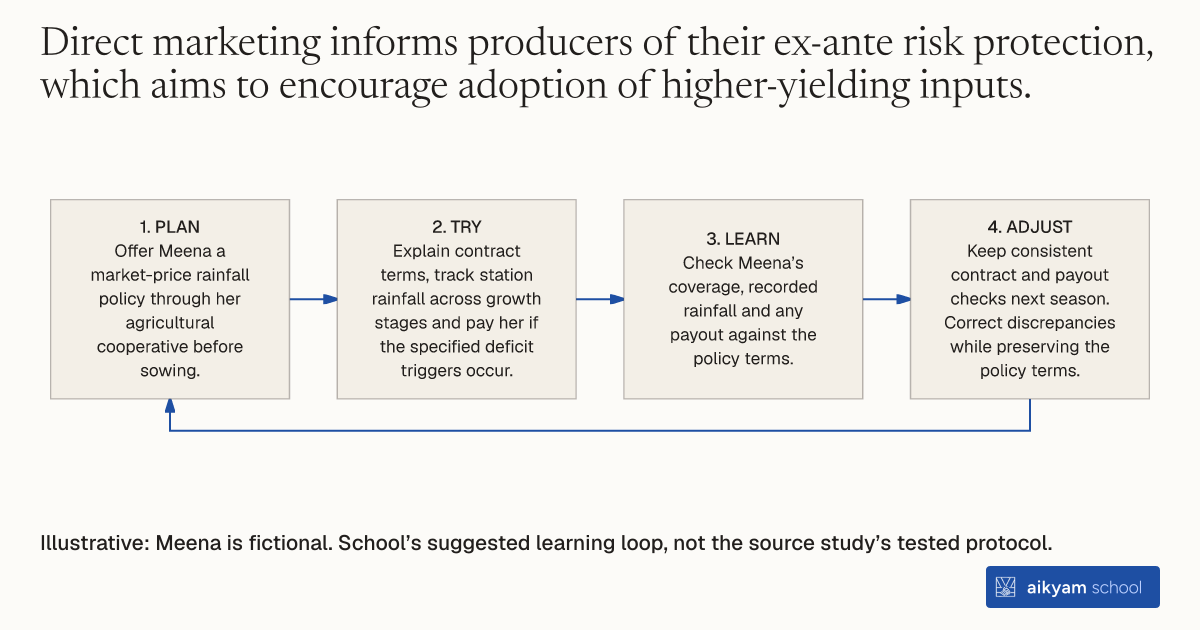
Try, learn and adjust
Check policy explanations and rainfall payouts
- Plan: Offer Meena a market-price rainfall policy through her agricultural cooperative before sowing.
- Try: Explain contract terms, track station rainfall across growth stages and pay her if the specified deficit triggers occur.
- Learn: Check Meena’s coverage, recorded rainfall and any payout against the policy terms.
- Adjust: Keep consistent contract and payout checks next season. Correct discrepancies while preserving the policy terms.
Illustrative: Meena is fictional. School’s suggested learning loop, not the source study’s tested protocol.
See source →School’s suggested, untested loop. Observe policy coverage, rainfall triggers and payouts; uptake or farm benefits are not assumed.
How
When to use
Smallholder farmers in drought-prone areas face severe weather risks that hinder agricultural investment. Standalone microinsurance attempts to market weather-index policies directly to individual producers through local cooperative structures. This approach targets rural households seeking protection against seasonal deficit rainfall.
Market standalone weather index insurance policies directly to smallholder farmers through producer cooperative networks to cover input expenses.
- Partner with a commercial insurer to design rainfall index insurance contracts covering specified input expenditure values for major regional crops.
- Select primary agricultural producer cooperatives to aggregate demand and facilitate policy distribution in rural villages.
- Train village extension officials and cooperative leaders to promote contract terms to member farmers.
- Offer retail policies to individual cooperative members during the pre-sowing sales period at market prices.
- Track regional weather station rainfall data across early, growth, and maturation stages of the rainy season.
- Distribute indemnity payouts directly to covered individual farmers when seasonal rainfall drops below specified deficit triggers.
Why it works
Aggregating sales through established cooperatives reduces administrative transaction costs for private insurers.
Example
Nyala Insurance marketed standalone rainfall index policies covering input costs across drought-exposed villages in Amhara, Ethiopia, but uptake without subsidies reached only 0.5% to 3% of cooperative members.
About the study
Participants
882 cooperative farming households across 49 villages in Amhara Region, Ethiopia.
Study Design
Randomized controlled trial testing standalone weather index insurance sales with randomized voucher subsidies and promotion across multiple agricultural seasons.
Results
Unsubsidized uptake remained between 0.5% and 3% across seasons, and receiving free insurance vouchers failed to produce significant increases in chemical fertilizer adoption (+3.1 percentage points, p > 0.1) or yield index (-0.02 SD, p > 0.1).